I’m not over this review of a self groomer for a three legged cat. Look at him. He hasn’t been able scratch his left side by himself since he lost his leg but now he can and he is living life the fullest. That is the face of a cat who has finally scratched an itch.
Tweet 1: Men, for all of history: Women and gays aren’t allowed Women and gays: Create something inclusive for everyone who isn’t a bigot Men: That’s gatekeeping
Tweet 2:
Men, for all of history: We’d be fine with you making your own games and comics and cartoons, we just want to keep the existing stuff for only us! Women and gays: Make new media for everyone Men: Not like that
Tweet 3: Men, for all of history: Never show any interest in cartoons and toys aimed at girls Women and gays: Revitalize an 80’s toy ad cartoon and make it current for the times Men: We are deeply concerned about this reimagining of our most favorite beloved character, where are her tits
Tweet 4:
Men: If media aimed at young girls doesn’t show exclusively women that I would like to fuck, how are these young girls going to know to grow up into women that I want to fuck? Misandry, also rainbow hair is poison
Tweet 5:
Men: Respond to this thread with Not All Men, Ur Using a Broad Tipped Brush, Ur Generalizing, etc Me: Yeah no shit, oh yeah also you’re muted now have being mad quietly
It all started with me pledging to read only women authors in 2014. But then I got a serious hankering for some Sherlock Holmes (who is, sadly, written by a dude). Thinking, “Surely there must be detective stories written by ladies! Lady detective stories even! Vintage lady detectives written by vintage lady authors!” And there are! Several hours later, here we are… (NB: Being an asexual lady myself, I consider the spinster sleuth an awesome and delightful protagonist, haters to the left.)
Catherine Louisa Pirkis (1841-1910) was a British short story writer and novelist. Her stories of disguise-mastering Loveday Brooke, who choses detecting over becoming a governess, were published in Ludgate Magazine, starting in 1894. Loveday Brooke stories: The Experiences of Loveday Brooke, Lady Detective (1894) .
Mary Roberts Rinehart(1876-1958) was an American novelist, playwright, and non-fiction author. Apart from her detective fiction, her co-written novel The Bat about a caped criminal inspired Bob Kane’s The Bat-Man. Her protagonists all fall in the spinster sleuth category. Rachel Innes novels: The Man in Lower Ten (1906) | The Circular Staircase (1908) . Letitia “Tish” Carberry stories: The Amazing Adventures of Letitia Carberry (1911) | Tish (1916) | More Tish (1921) | Tish Plays the Game (1926) | Tish Marches On (1937) . Cornelia van Gorder one-shot mystery: The Bat (1920) co-written with Avery Hopwood.
Editing my post to add: Baroness Emma Orczy (1865-1947) was a Hungarian-born British novelist, playwright, artist, and translator. Although she is predominantly famous for her novels about The Scarlet Pimpernel she also published a book about a female crime-solving duo. Lady Molly stories: Lady Molly of Scotland Yard (1910) .
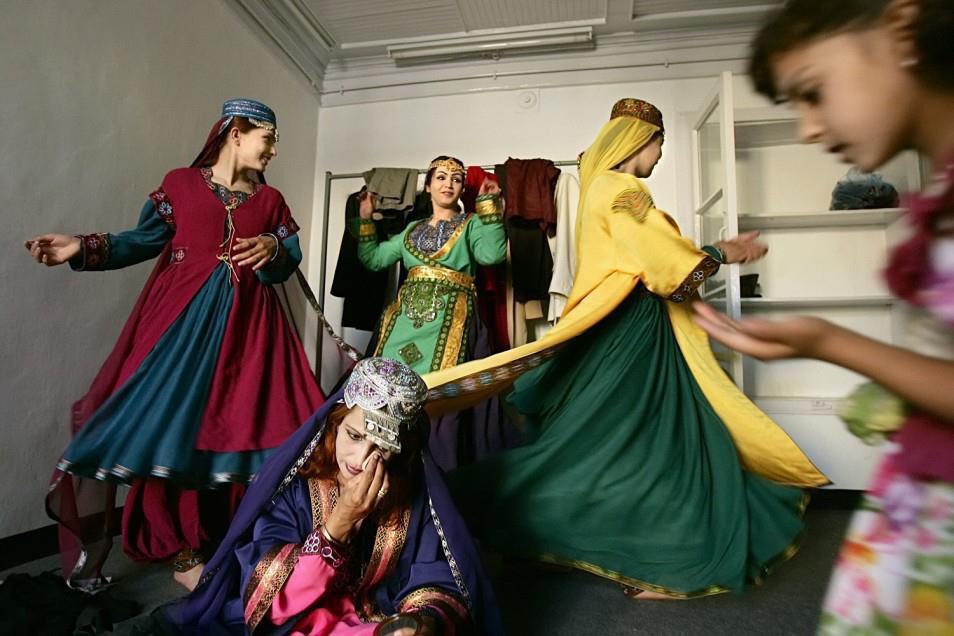
Afghan women prepare backstage to perform Shakespeare in Kabul for the first time since 1979.
Some people have been reblogging asking about the production, and I recognised the costumes, so here’s what I know! It’s a production of Love’s Labour’s Lost, in 2005, by the group Roy-e-Sabs. The play was translated both into Dari and into an Afghan context (source):
“The play’s setting was changed from Shakespeare’s French Navarre to Afghanistan, with Navarre now the King of Kabul, and the ladies visiting, not from the French court, but from Herat, a city with a long artistic heritage. When Jaber’s production toured the country beyond Kabul in the summer of 2006 and performed in Herat, the King was now from Herat, the ladies from Kabul; the play was also performed in Mazar-e-Sharif. The play’s comic “masque of Muscovites” also had to be transformed—given the still-fresh and painful memories of the Soviet invasion and occupation—to a masque of Indians, with other Bollywood elements added in, such as weaving slapstick Bollywood songs into the play.“
There’s a book about it, called Shakespeare in Kabul, and the same company also did the Comedy of Errors at the Globe to Globe festival in 2012, which I saw and was hilarious. Like Love’s Labours, it translated the play to Afghanistan, setting it in Kabul instead of Ephesus, with the ‘Syracuse’ twins instead from buzzy artistic Samarkand. It used the play to satirise strict sharia law, especially the double standards it puts on women in public.






















 ¯_( ಠ_ಠ)_/¯