Even if you don’t have a cat please reblog this for all your followers who may have their own precious little baby.
I HAD NO IDEA ABOUT TUNA OMFG
If I remember rightly it’s the trace elements of mercury in canned tuna that is toxic to them. Their kidneys can’t filter it out like human kidneys can.
ok im gonna break this down a bit because some of these are BLATANTLY untrue and it kills me every time i see this.
alcohol: not very good for humans, either, but alcohol effects pets the same way it effects humans: targeting the brain and the liver. the issue? it takes way less to kill your cat than it does a human. you weigh, on average, at least 100 pounds (or 10x) more than your cat does. 3 teaspoons of liquour could kill your cat. don’t do it. alcohol WILL poison your cat.
chocolate:
theobromine (and to a lesser degree, caffeine) is the issue with this one. humans? we can break this down in our bodies. cats, dogs, birds, ferrets? they can’t. it usually takes a pretty big amount of theobromine to cause a pet to actually die, though. it’s present in cocoa, so the higher % of cocoa in a chocolate, the less needs to be ingested to cause serious, life-threatening effects. baking chocolate has a high concentration of theobromine and 1 square can kill a cat or small dog. white chocolate is a low risk, on the other hand. chocolate CAN poison your cat, especially DARK and BAKING chocolate.
caffeine: same story as alcohol: not that great for humans either, causes similar effects as in humans… just quicker and with less caffeine ingested. elevated heartrate, seizures, etc. can be seen. dogs and cats are more sensitive to the effects than humans are. caffeine WILL poison your cat.
dairy: cats are lactose intolerant and so their bodies cannot properly break it down– much like how we can break down theobromine and cats/dogs can’t. however, it’s not going to poison your cat, just give them diarrhea and other gastrointestinal upset. dairy WILL NOT poison your cat, but will cause gastrointestinal upset and diarrhea, so it is strongly recommended to not give dairy products to your pets.
fat trimmings: fat trimmings are just fat. if you feed fat to your cats, they will become fat and/or it will increase the level of lipids in the blood, leading to diseases and complications like chronic pancreatitis, which can be fatal. fat trimmings WILL NOT poison your cat, but will lead to disease that can be fatal, so it is strongly recommended to not feed fat trimmings to any pets.
raw meat: cats can eat raw meat. cats are obligate carnivores. cats are designed to only eat meat, and raw meat is not of serious risk to them. disease carried in raw meat? not a problem when you are a cat who has evolved over millions of years to eat raw meat. i hate hearing “cats can’t eat raw meat!” from people with outdoor cats. you realise your cats are eating raw lizard and bird, right? raw meat has more nutrients than cooked meat (which we eat veggies & fruits to compensate for– cats can’t digest these) and, obviously, there are some diseases and bacteria that cats aren’t immune to but cats are less likely to eat rotten meat than dogs are, anyway. treat the meat like you treat human meat and it’s totally fine. cats are DESIGNED TO EAT AND DIGEST RAW MEAT! IT’S PERFECTLY FINE TO FEED YOUR CAT RAW MEAT, but make sure that the meat is in-date and properly stored/cared for. rotten or spoiled meat CAN lead to disease and poisoning, but the same goes for 90% of the animal population!
eggs: its ok to feed your cat eggs. im not even sure why this is a question. raw eggs rarely carry salmonella and even humans rarely contract salmonella from infected eggs. your average cat will never contract salmonella from raw eggs, only in an immuno-compromised cat would this ever be an issue. cats can safely eat raw and cooked eggs, as salmonella is pretty much only a concern in an immuno-compromised cat in the first place.
fish: see raw meat above. fish, however, is a bit of an exception because of higher levels of mercury & low levels of taurine and differing balances of phosphate and calcium mean that it’s not a sustainable diet for cats and could lead to mercury poisoning or bone disease if it is the only protein given. when given ~1 time a week and with varied proteins there is no issue. again, cats are DESIGNED TO EAT AND DIGEST FISH AND OTHER MEATS! however, previous warnings about storing fish correctly still applies, and proteins should be varied due to fish having different levels of phosphorous, calcium, and taurine and mercury content. a primary diet of fish CAN lead to bone disease or mercury poisoning in extreme cases.
grapes and raisins: admittedly, this one is a bit of a wild card. some pets eat raisins/grapes without an issue, but in others, these can cause renal failure and death rapidly. we still don’t know why. animals with prior kidney issues are more likely to be effected by grape/raisin toxicity, and cats are more likely to have kidney issues due to many cats not getting adequate moisture in their diet. grapes and raisins MAY lead to poisoning in some cats and dogs, especially those with pre-existing kidney conditions.
onions and garlic: yes! all members of the allium genus (shallots, scallions, leeks, etc. are included) contain thiosulphate which, when ingested by cats and dogs, can lead to a serious condition in the blood known as hemolytic anemia. basically: their red blood cells burst. this can be fatal and a small amount of onion/garlic/etc. is needed to cause clinically significant issues. onions, garlic, and other members of the allium genus CAN and WILL poison your pet in even small amounts.
tuna: see fish above. canned tuna tends to be soaked in oil which leads to the same issues as fat trimmings in increasing lipid count in the blood. sashimi quality tuna will also have higher concentration of mercury and shouldn’t be consumed more than occasionally in the cat’s diet. canned tuna in oil is often too fatty and leads to the same issues as eating fat trimmings, however, tuna steak/sashimi/etc. quality tuna is the same as other fish: occasional inclusion in the diet is fine!
xylitol: relatively small quantities of this (an artificial sweetener) will cause a sudden drop in blood sugar in dogs, which can lead to comas, seizures, or death. many times, if they are not rushed to the hospital immediately, they will die, and even then, they may suffer permanent liver damage. however… cats are not adversely affected, and typically aren’t attracted to foods w/xylitol in it in the first place. xylitol is NOT likely to poison your cat, but small amounts can KILL your dog, moreso than chocolate!
Please take your time reading this, I think it’s important for everyone to know it especially for the ones that own a cat. Thanks to @ghirahim for correcting the information.
one of the dogs I groomed today was skunked at some point, and every time I bathe her the old skunk smell resurfaces and it is fucking disgusting. because of that, and because the smell is still lingering in my nose and brain, I’m going to take this opportunity to advise you all on how to deal with a skunked cat or dog.
a common method, one that is even advised on the BC SPCA website, is to use a combination of hydrogen peroxide, baking soda, and dishsoap. do not do this. people use this as a cleaner for grout and a bleach for hair. it’s not appropriate for use on animals, particularly when there are safer methods available.
so with that in mind, here’s an effective method to best mitigate the smell should your pet get skunked:
do not get the animal wet. as soon as you get them wet, the hair follicles will close up and then the spray is locked in. for dogs, it takes up to seven years for a hair follicle to turn over which means your dog could potentially smell like skunk for literal years.
instead, load them up with baking soda. I’m talking so much that a black dog turns white. let it sit for ten minutes, or more if the animal is not in distress. you can even shake it out and add more. do not rinse.
add concentrate dog shampoo or dawn dishsoap. I’ve been told repeatedly that dawn is the only acceptable dishsoap to use on animals (and only as a last resort, as dishsoap simply is not designed for use on animals). if you can get your hands on proper concentrated dog shampoo that’s better. lather that shit up and add vanilla extract, then rinse. if you are still getting wafts you can add more baking soda even though the water has set.
for dogs, when they are cleaned to the best of your ability, you can add conditioner (my grooming instructor taught me not to use conditioner on cats, and she had a reason but I cannot remember what it was, so I’m erring on the side of caution here in not advising it). if you can, book a bath with a groomer for 3-4 weeks later (given the 28 day cycle of skin on average) or bathe at home, not for the clean but for the conditioner. this is to offset the strip of oils from the coat during the initial deskunking.
unfortunately by the time I have the opportunity to share this method with people, they’ve typically already stuck their dog in the tub and bathed them or bleached them with hydrogen peroxide and baking soda. hopefully this helps prevent some unfortunate people and pets from ending up in that scenario.
have i ever told y’all the story about how a snake knew I was trans years before I did
okay so
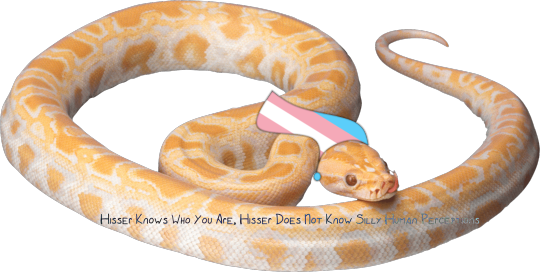
my 7th grade social studies/8th grade science teacher (he did both classes. Somehow…) had a snake lovingly named Hisser. Hisser would occasionally be taken out to crawl and he was held by kids and when there were fire alarms Hisser was taken along, usually to his chagrin.
This was one of those days where we had in class work time and most of us were just chilling and so Mr. A got Hisser out and started passing him around.
Every girl student that he came to, he would immediately snuggle up to, wrap around their arms, and get cozy. With boy students, he would just sort of sit in the coiled lump that he’d been handed in. This was true with just about every single student, and Mr. A said that Hisser likes girls a lot better than guys and this has been thoroughly proven by Hisser’s attitude.
Then Hisser was handed to me. He was a loveable cold scaley rope as you would expect, but he didn’t coil around my arms. He didn’t get cozy. He just sat there. And Mr. Anderson said, “Huh. That’s weird. He usually likes girls.”
I passed the snake to my friend and surely enough, Hisser wrapped around her arms and got cozy.
I came out as a trans guy about 7-8 years later, and just recently realized that Hisser was right about me not being a girl all along.
I’ve also decided that whenever anyone asks me “Why I think I’m a boy,” which is my LEAST favorite question ever, I’ll just tell them that a snake told me a long time ago.




 ¯_( ಠ_ಠ)_/¯