It’s like if you took an academic/political tornado and placed it in a room and just let it run its confused little course until everything was destroyed.
-Courf
I’d say it’s like raising a child who happens to be an overtired savant.
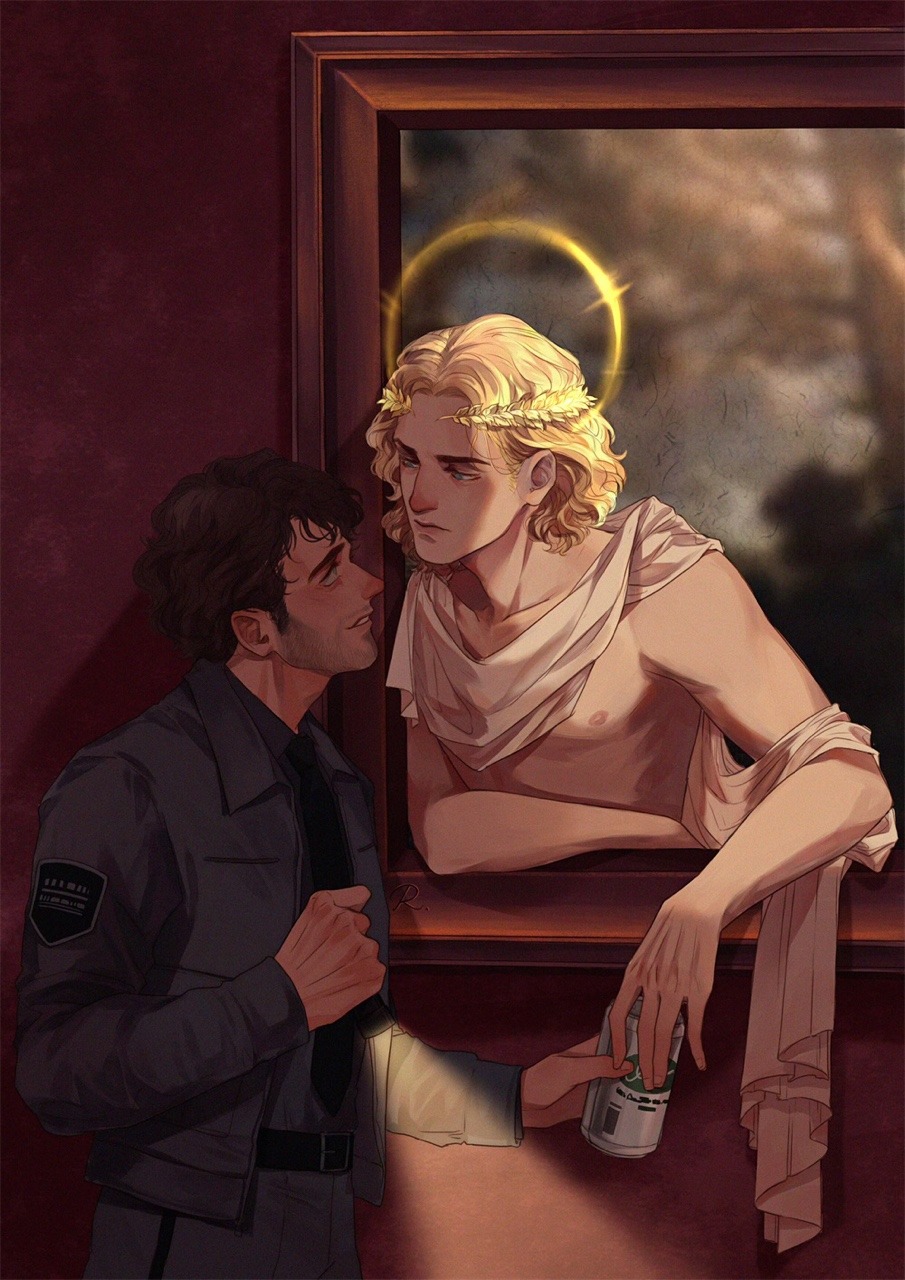
Victor Hugo, although constantly pulling references out of nowhere, rarely makes an allusion to something without having implicit intentions behind it. His constant comparison of Enjolras to famous Greek and Roman pretty boys and his relationship with Grantaire to legendary male relationships can be taken as a veiled but intentional way to write him as queer.
In the context of Enjolras as an educated character living during the 1830s in Paris it can be assumed that he was aware of Antinous as a historical figure and would most likely be at least somewhat influenced by Greco-Roman ethos. Today we have the full context of the development of Antinous’s cultural influence as well as knowing what happens next for France historically after the June Rebellion, as did Hugo when he wrote Les Miserables in 1862. It is a whole new level of foreshadowing when you read the brick knowing what happens to Antinous and how he is more beloved and worshiped after his tragic death.
The parallels of Antinous and Enjolras are striking when we look at how they were both viewed and remembered by others. Enjolras wanted nothing more than to rally the people for change, to have his movement be loved and listened to by the public and to be immortalized in this veneration. And this kind of worship is exactly what befell Antinous, inspiring a city and later a cult and religion that can still be found today. Both die tragic and young with their male counterparts at their side, inspiring many postmortem.
Because of the obviously intended parallels between Enjolras and Antinous it seems safe to say that there are more similarities that are a little more implied. In the Wilbour translation Enjolras is written as being not interested in women at all, which contrasts the amount of Amis who are constantly talking about women and how to acquire their attention (Joly, Legle, Grantaire, Marius, etc.)
“His twenty-two years of age appeared seventeen; he was serious, he did not seem to know that there was on the earth a being called woman.” (Hugo, Part 4, Chapter 1)
This could be taken a number of different ways but overall each interpretation places Enjolras under some part of the queer umbrella. His disinterest in women is further described as,
“Had any grisette…seeing this college boy’s face, this form of a page, those long fair lashes, those blue eyes, that hair flying in the wind, those rosy cheeks, those pure lips, those exquisite teeth, felt a desire to taste all this dawn, and tried her beauty upon Enjolras, a surprising and terrible look would have suddenly shown her the great gulf…” (Hugo, Part 4, Chapter 1)
Woooooh boy! Okay so not only is he not interested in women he is also, as if not already otherwise stated before in grave detail, VERY PRETTY. Antinous was also known for his severe beauty and as Caroline Vout writes in Power and Imperialism in Imperial Rome, “his adoption as a gay icon.” So the similarity between the two can also be found in that they were both, at least assumed on Enjolras’ side, very pretty and very gay. And these connections are all being made without even touching on the subject of Antinous’ relationship with Hadrian and Enjolras’ relationship with Grantaire! The intensity his disinterest in women is written could also be read as his dedication to the revolution (and only the revolution) and could very well be understood as Enjolras being asexual or aromantic.
It is pretty easy to read Enjolras as queer even without looking into his written and performed relationships with others. Whether Enjolras be seen as gay or asexual or just simply a powerful force representing the people of the revolution*, many of his identities are queer.
So I guess what im really saying is that having the background info on Antinous, as well as other literary and historical characters Enjolras (and Grantaire) are compared to, gives queer readers some hard facts to work with when understanding subtext. Even when reading the brick without that knowledge you can still pretty easily find queer themes throughout it. So it’s like “you think this is gay now? Check this shit out!”
*I’m also addressing that Enjolras is described as being rich in the book even though he is leading a revolution for workers and the people. He is hardly marginalized the way queer activists are today but I feel that comparison can still be made.
Actually I’ve never thought about it until now, but I like it and I’m getting some ideas!
When Enjolras was little, he always had trouble with speech. He was okay talking to his family and friends, but when he had to present in front of his class he’d always talk quietly and stutter.
His classmates made fun of him for it, and he closed himself off.
When he got to college he had to take a required public speaking class, and he was terrified.
He eventually met and joined Les Amis and would quietly give his input to Combeferre, who would share it for him.
As he began to feel more comfortable with Les Amis though, he was able to share his own thoughts and opinions. They appreciated him for who he was, not looking down on him for any disability.
Once he got comfortable with speaking in front of Les Amis, they encouraged him to speak for a small protest. He didn’t stutter once.
Enjolras came to realize that when he was speaking about something he was passionate about, he could do it clearly, and if he ever got nervous, he would just look to his friends and gather courage from them.
Hope that was okay! I don’t have a lot of experience with autism, so if any of that was inaccurate or offensive please tell me!














 ¯_( ಠ_ಠ)_/¯