in french you dont say “i love you” you say “permets-tu” which is closer to “do you permit it?” i love that. “do you permit it” you are hot and blond and we are going to die. you are like a statue or a god or an angel. i am really gay for you.
wtf we don’t say “permets-tu”????????????
wtf we don’t say “permets-tu” we say “je t’aime” you dumbass
french people who dont get les miserables jokes
Grantaire:
Permets-tu?
Enjolras: wtf
we don’t say “permets-tu” we say “je t’aime” you dumbass
(argument
ensues)
Soldiers: *look
one another in confusion* *slowly lower their arms* Maybe… we should give
them a minute?
I once told @ragnar-rock i’d tell her about this scene and I feel like I might burst
Remember that Grantaire could have gotten out of this alive. He could have stayed hidden, sobering up in a corner for days on end but the silence awoke him. The café was such a lively, noisy place that the silence is deafening. We have a word for it in French : un silence de mort. And it literally is a silence of death.
And as other people pointed out, he doesn’t even spare a glance to the guards, it’s no use, it’s already over. He only has eyes for Enjolras, etherally beautiful in all his glory and tragedy, the flamboyant ideal of the revolution embodied in a single man. And if Enjolras is the allegory of an ideal, Grantaire is the allegory of Paris and France itself. “The people too must rise”, right? Well guess what, the people, embodied by Grantaire, DID RISE. The cynic, the one who took great care in beliving in nothing rose and marched to his death because he believed in Enjolras, aka the Revolution.
I love his little stumble, it’s almost like he can’t wait to reach Enjolras, he’s drawn to him like a moth towards the light. Because it’s what Enjolras is, the light in the darkness, the promise of better days. And Grantaire chooses to die because life would be meaningless without Enjolras, without the marble lover of liberty. “La liberté sinon rien” : liberty or nothing.
Grantaire didn’t stumble to his death. Grantaire held salvation by the hand and looked at death right in the eyes, defiant until the very end. France and Liberty, so indissociable, dying together rather than being apart.
I had always been on the “Enjolras is tall” train, until I imagined Enj standing on a counter in his apartment screaming about something and R just scooping his tiny angry boyfriend off the table
victor hugo: yeah the enjolras and grantaire dynamic is the same as achilles and patroclus, orestes and pylades and alexander the great and hephaestion
Okay though! This’ll just be me ranting about queer coding in general, and may turn into an essay.
First things first, and it’s not even too mythological: Enjolras being described as a ‘Savage Antinous’. Antinous was the lover of Hadrian (emperor; Antinous’ much older sugar daddy), and BELIEVE IT OR NOT super gay. Beginning in the 19th century, Antinous was used as a way of saying someone was gay without actually saying it (and when did Hugo write Les Mis? Oh dear, the 19th century!). Antinous: young, beautiful, very gay, described as a twink (literally; ‘eromenos’ was a historical way of saying pillow princess, and it’s used to describe Antinous).
Hugo? Used Antinous as a way of saying ‘yes, gay’ without actually saying it. If he had gone out and said it, he never would have been published, as simple as that. This was also the reason he described Enjolras as ‘chaste’ and ‘virginal’; being gay? Not the worst thing ever but not great. Being gay and sexually active? Absolutely not. Many authors used chaste as a way of saying ‘gay but not gay enough for you to refuse to publish my book’.
Side note: Antinous is often compared and depicted to a son of Apollo. Apollo.
Other couples they are compared to: Orestes and Pylades. Achilles and Patroclus. Nisus and Euryalus.
To unpack that:
Nisus and Euryalus – Virgil describes them as friends AND lovers, who – believe it or not! – die together. (Also Euryalus was described as ‘eromenos’ as well)
Orestes and Pylades – okay this one is! Okay kills me. Orestes and Pylades? Are a prime example of authors using coding. Their relationship has always been used as a way of describing homoeroticism without actually saying the words. Also – Orestes is a tiny bit sentenced to death. Pylades refuses to leave his side, even though he had not committed the crime.
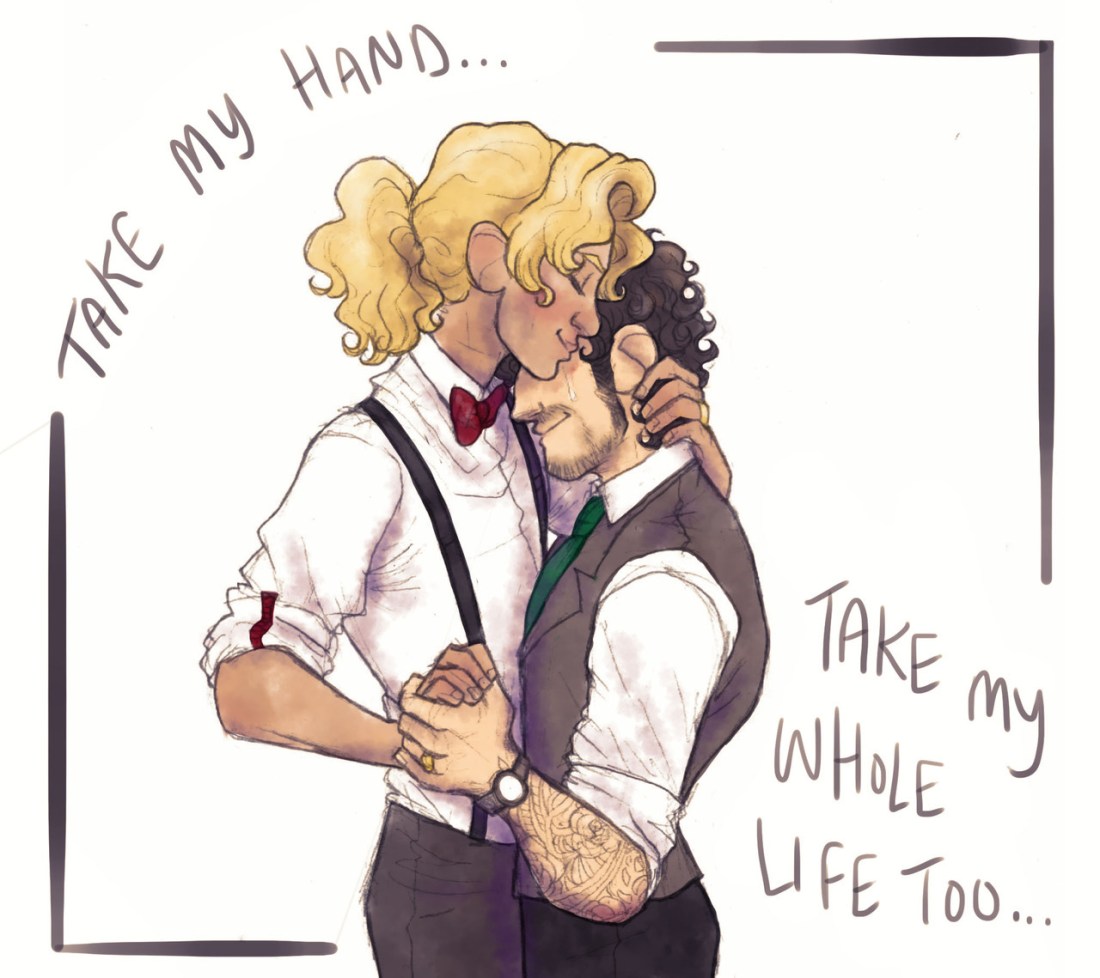
Grantaire was described as ‘an unaccepted Pylades’ in his first introduction. He then dies next to Enjolras (after asking permission), therefore is an ‘accepted Pylades’, which just kind of hurts all over.
Believe it or not, the very queer Lord Byron used Orestes and Pylades in letters to his male lovers. Also used by him and others? Achilles and Patroclus.
Honestly, is there any reason to explain Achilles and Patroclus except to say: used by every author writing a queer character, or even writing to partners. From the aforementioned Lord Byron to Oscar Wilde and everything and everyone in between – queer coding at its most obvious and purposeful.
All dying next to/for each other. All queer. All historical uses of coding.
(Also don’t think I didn’t notice you saying @enjoloras instead of enjolras)
I’m glad you like my blog! And I’ve been learning French since I was 13, but I’m not fluent in it (yet) haha.
I can’t say that enjoltaire was real, because the only person who could really say that was Victor Hugo haha. I do ship them together but all I can tell you is which parts of Les Miserables show that there could have been something.
Actually I already talked about it a while ago in THIS ASK. But I’ll give you some more details!!!
Just, about the gay rights in the 19th century France – after 1791 gay sex was no more a capital crime in France. It still wouldn’t really let two gay men to be out and be in a relationship, but it’s important to remember that it was completely normal for two men/two women to live together, “just as friends” back then. It was normal for them to cuddle and sleep in the same bed. LGBT history is more complex than most people think it is!
But now back to Les Mis – when describing Enjolras, Hugo compares him to many maaaaany well known gay characters/people.
“He was a savage Antinous.” – Antinous was a lover of the Roman emperor Hadrian. He died when he was in his early twenties and in the 19th century he replaced Ganymede as a western gay icon. Oscar Wilde often talked about him.
“the bare throat of Evadne would have moved him no more than it would have moved Aristogeiton; he, like Harmodius, thought flowers good for nothing except to conceal the sword” – both Aristogeiton and Harmodius were lovers who killed the tyrant of Athens.
And while talking about Grantaire and Enjolras’ relationship he mentions not only gay people but gay people who were in relationships.
“They are Pollux, Patrocles, Nisus, Eudamidas, Ephestion, Pechmeja.”
Patroclus – a character from Homer’s Iliad. He was a close friend and probably a lover of Achilles.
Nisus – Nisus and Euryalus were lovers from Virgil’s Aeneid.
Ephestion, Hephaestion – was a very close friend of Alexander the Great. They both compared themselves to Achilles and Patroclus and many believe that they were lovers.
Pechmeja – Pechmeja was a writer in the 18th century. He was a friend of
Dubrueil, a doctor. When the writer got sick, his friend stayed with him until he was healthy again, but even then he didn’t move out and soon both men started living together. A few years later it was
Dubrueil
who fell sick and this time the illness was both contagious and terminal, but his friend refused to leave him alone.
Dubrueil
died in April 1785 and Pechmeja died a month later.
“In the series O and P are inseparable. You can, at will, pronounce O and P or Orestes and Pylades.” – Orestes and Pylades avenged Orestes’ father, Agamemnon after the man had been killed by his wife. Their relationship is sometimes interpreted as romantic.
I hope it helps just a bit with understanding their relationship and I totally encourage everyone to study all comparisons etc Hugo made because they are very interesting!






 ¯_( ಠ_ಠ)_/¯