i want to share with you some of my favourite graffiti from Pompeii
“Weep, you girls. My penis has given you up. Now it penetrates men’s behinds. Goodbye, wondrous femininity!“
“Amplicatus, I know that Icarus is buggering you. Salvius wrote this.“
“We two dear men, friends forever, were here. If you want to know our names, they are Gaius and Aulus.“
“Floronius, privileged soldier of the 7th legion, was here. The women did not know of his presence. Only six women came to know, too few for such a stallion.“
“On April 19th, I made bread.“
“
I have buggered men.“
“If anyone does not believe in Venus, they should gaze at my girlfriend.“
“It took 640 paces to walk back and forth between here and there ten times.“
“Chie, I hope your hemorrhoids rub together so much that they hurt worse than when they every have before!“
“Epaphra is not good at ball games.”
“Two friends were here. While they were, they had bad service in every way from a guy named Epaphroditus. They threw him out and spent 105 and half sestertii most agreeably on whores.“
“Secundus likes to screw boys.“
I’ve always loved these. Humanity has never fucking changed.
More fun facts about ancient Celtic marriage laws: There were no laws against interclass or interracial marriage, no laws against open homosexual relationships (although they weren’t considered ‘marriages’ since the definition of a marriage was ‘couple with child’), no requirement for women to take their husband’s names or give up their property, but comedians couldn’t get married
It’s Adam and Eve not Adam Sandler and Eve
I want to expound upon “comedians couldn’t get married” thing because it’s actually really interesting.
Satire was respected in Ancient Ireland. It was thought to have great power, enough to physically maim the subject one was making jokes about. Satirists could bring down kings with a witty enough insult. That was actually their original function. When the king didn’t do right by his people, a bard was supposed to compose a poem so scathing it would raise welts on the king’s skin to oust him (it was illegal for a “blemished” king to rule.) Unwarranted satire was considered a form of assault.
So what it boils down to is ancient Celts being like “These people are too dangerous to reproduce. DO NOT TRUST THEM WITH CHILDREN. EVER.”
it’s hilarious to me when people call historical fashions that men hated oppressive
like in BuzzFeed’s Women Wear Hoop Skirts For A Day While Being Exaggeratedly Bad At Doing Everything In Them video, one woman comments that she’s being “oppressed by the patriarchy.” if you’ve read anything Victorian man ever said about hoop skirts, you know that’s pretty much the exact opposite of the truth
thing is, hoop skirts evolved as liberating garment for women. before them, to achieve roughly conical skirt fullness, they had to wear many layers of petticoats (some stiffened with horsehair braid or other kinds of cord). the cage crinoline made their outfits instantly lighter and easier to move in
it also enabled skirts to get waaaaay bigger. and, as you see in the late 1860s, 1870s, and mid-late 1880s, to take on even less natural shapes. we jokingly call bustles fake butts, but trust me- nobody saw them that way. it was just skirts doing weird, exciting Skirt Things that women had tons of fun with
men, obviously, loathed the whole affair
(1864)
(1850s. gods, if only crinolines were huge enough to keep men from getting too close)
(no date given, but also, this is 100% impossible)
(also undated, but the ruffles make me think 1850s)
it was also something that women of all social classes- maids and society ladies, enslaved women and free women of color -all wore at one point or another. interesting bit of unexpected equalization there
and when bustles came in, guess what? men hated those, too
(1880s)
(probably also 1880s? the ladies are being compared to beetles and snails. in case that was unclear)
(1870s, I think? the bustle itself looks early 1870s but the tight fit of the actual gown looks later)
hoops and bustles weren’t tools of the patriarchy. they were items 1 and 2 on the 19th century’s “Fashion Trends Women Love That Men Hate” lists, with bonus built-in personal space enforcement
Gonna add something as someone who’s worn a lot of period stuff for theatre:
The reason you suck at doing things in a hoop skirt is because you’re not used to doing things in a hoop skirt.
The first time I got in a Colonial-aristocracy dress I felt like I couldn’t breathe. The construction didn’t actually allow me to raise my arms all the way over my head (yes, that’s period-accurate). We had one dresser to every two women, because the only things we could put on ourselves were our tights, shifts, and first crinoline. Someone else had to lace our corsets, slip on our extra crinolines, hold our arms to balance us while a second person actually put the dresses on us like we were dolls, and do up our shoes–which we could not put on ourselves because we needed to be able to balance when the dress went on. My entire costume was almost 40 pounds (I should mention here that many of the dresses were made entirely of upholstery fabric), and I actually did not have the biggest dress in the show.
We wore our costumes for two weeks of rehearsal, which is quite a lot in university theatre. The first night we were all in dress, most of the ladies went propless because we were holding up our skirts to try and get a feel for both balance and where our feet were in comparison to where it looked like they should be. I actually fell off the stage.
By opening night? We were square-dancing in the damn things. We had one scene where our leading man needed to whistle, but he didn’t know how and I was the only one in the cast loud enough to be heard whistling from under the stage, so I was also commando-crawling underneath him at full speed trying to match his stage position–while still in the dress. And petticoats. And corset. Someone took my shoes off for that scene so I could use my toes to propel myself and I laid on a sheet so I wouldn’t get the dress dirty, but that was it–I was going full Solid Snake in a space about 18″ high, wearing a dress that covered me from collarbones to floor and weighed as much as a five-year-old child. And it worked beautifully.
These women knew how to wear these clothes. It’s a lot less “restrictive” when it’s old hat.
I have worn hoop skirts a lot, especially in summer. I still wear hoop skirts if I’m going to be at an event where I will probably be under stage lights. (For example, Vampire Ball.)
I can ride public transportation while wearing them. I can take a taxi while wearing them. I can go on rides at Disneyland while wearing them. Because I’ve practiced wearing them and twisting the rigid-but-flexible skirt bones so I can sit on them and not buffet other people with my skirts.
Hoop skirts are awesome.
Hoop skirts are a fucking godsend in summer. Nothing’s touching your legs. It’s like wearing a big box underneath whic you’re naked, temperature wise.
Did this with a bustle rather than a hoop skirt, but was quite comfortable running around in said bustle, shirt, full corset, gloves, and overskirt in 117 degrees for a con. It was far more comfortable than the more modern dress i wore the next day.
Writer Note: this is fascinating research information not restricted to just the Victorian era under discussion. Though it’s stating the obvious, the obvious often needs to be stated: when seemingly-awkward garments like crinolines and hoop-skirts (or ruffs, or houppelandes, or etc.) were everyday wear, the wearers knew how to move in them because of practice.
For instance, how not to clear a table with a gesture while wearing sleeves like these…
Fashionable footwear has been weird for centuries.
Think of chopines, pattens, poulaines,
non-fetishy-y high heels, or platform boots worn with bell-bottom jeans so long and wide
that without the platforms
they trailed along the ground. The 1970s is called “the decade that style forgot” for good reason.
Elton John’s stage platforms aren’t as exaggerated as you think…
And then there are the doeskin breeches claimed in some fiction as fitting so tightly the
inside had to be soaped to get them on, going commando was compulsory, and the wearer couldn’t sit
down.
You’d certainly believe it from portraits like this one, “Hunter in a Landscape with his Dogs”, said to be General Thomas-Alexandre Dumas, father of Alexandre Dumas the novelist, with legs apparently clad in just a thick coat of paint. (X-skin breeches would seem more suitable for hunting, but these may represent cotton “inexpressibles” which really did fit like that.)
Like the supposed problems with crinolines etc., not true. Research and reconstruction has shown that doe / buck / sheepskin
breeches have natural stretch and recovery; a common comparison is to
old, well-worn jeans. Of course the artist also wanted to show that his subject “had a good leg” (look up “artificial calves” and be amused) and wasn’t letting realism get in the way of doing so.
This is a bit more like it.
Nowadays “deportment” seems to have an aura of outdated snobbishness – upper-class debutantes learning to curtsey, or walk with books balanced on their heads – but ”porte” in French means “carry”
and the old meaning of deportment was “how to carry yourself”; how to move properly, without inconveniencing yourself or others.
Various historical-costume books point out that “moving properly” in some periods – memory suggests the court of Louis XIV at Versailles was one – meant a sequence of artificial, prescribed gestures, partly enforced by the clothing and partly by court protocol. IIRC one description was of “movements as precisely delineated as the steps of a formal dance”, and getting them wrong resulted in social mockery.
Elizabethan men were taught, as part of their deportment, how to move while wearing the long rapiers of the period; that hand-on-hilt stance in portraits isn’t drama, it’s control.
Once familiar with the length of the sword, they know exactly what shifting the hilt one way or another will do to the rest of it – and the people, furniture and crockery behind them – without needing to look. IIRC the technique is still taught to actors today.
Crinolines, bustles, bloomers, breeches, inexpressibles and all the rest were clothing; after reading about peculiar but oh-so-stylish ways of standing and moving like the “Grecian bend” and “Alexandra limp”, the Kink’s satirical 1960s hit “Dedicated Follower of Fashion” isn’t just a song any more…
:->
Even better than the version I posted before.
I would note that I have a RenFaire style corset and I have run significant distances, sword fought, and danced in various styles without any discomfort. The only thing I can’t do is bend over. It actually forces you to pick things off the ground safely. It’s not wasp waist tight, partly because I have abs and don’t compress like that (which might be part of the wasp waist thing. Being able to do that said you didn’t have abs…and thus didn’t work for a living, which has often been a thing with women’s fashion).
This is all really interesting and new to me! And I have thought of deportment as a snobbish thing all my life, but now I’m wondering if early lessons in it would have been a good thing for clumsy and oblivious folks like me.
Somebody should…I wonder if I can convince some cosplayers to do a panel about this. Both for authenticity and because some of them need to learn what happens to their sword when they turn around quickly…
I’m amazed how few people understand what wearing a real corset is like. It isn’t uncomfortable in the slightest to me, and it’s actually quite fun. People think if you wear a corset you’re going to crush your bones or something. It just simply isn’t true.
If you’re intentionally waist training (it’s a kink with some people) then it will have an effect. Otherwise, a correctly-fitted corset provides more support than a typical bra, it also supports your back – I do wonder if women had fewer back problems in times when they were common, and I do know women who wear them instead of back braces…
honestly? even serious waist training (which isn’t always a kink) shouldn’t hurt hurt. Depending on the person and how the corset fits there might be some tension, sure, but there’s this whole process that you should be going through when you first get your corset(seasoning) that basically allows your body to get used to it. It might be a little uncomfortable for someone unused to it, but a properly fitting corset won’t hurt (it can also increase flexibility in the obliques – I wasn’t even seriously waist training last school year and I still felt looser in the sides at the end).
Some people today wear corsets because it def provides a lot of support to large breasts, and custom corsetiers sometimes specialise in making medical corsets for scoliosis and stuff.
And yeah, corsets really often were worn by working women! Not just the delicate ladies in parlours, but also farm women who had to haul 50 lb sacks of feed or whatever. The corsets would function the same way a weightlifter’s belt or back brace would today, keeping everything aligned and providing support.
With the super heavy dresses and skirts, too, it helps to provide support for the weight of the cloth over the hips so the skirts don’t sag.
And on the topic of corsets, yes, men’s corsets are a thing. They’re a lot harder to get and you might have to hunt down a corsetiere to make one custom, but they do exist. They’re designed to slim the waist in a triangular fashion that makes your shoulders look broader.
Just try to avoid wearing a corset for more than 8 hours without a break.
shoutout to 10th century norway for having the only medieval penal code (gulaþinglög) i’ve read that not only doesn’t suggest you torture people but explicitly says tortured confessions are made out of fear and you should specifically not listen to them. good job 10th century norway
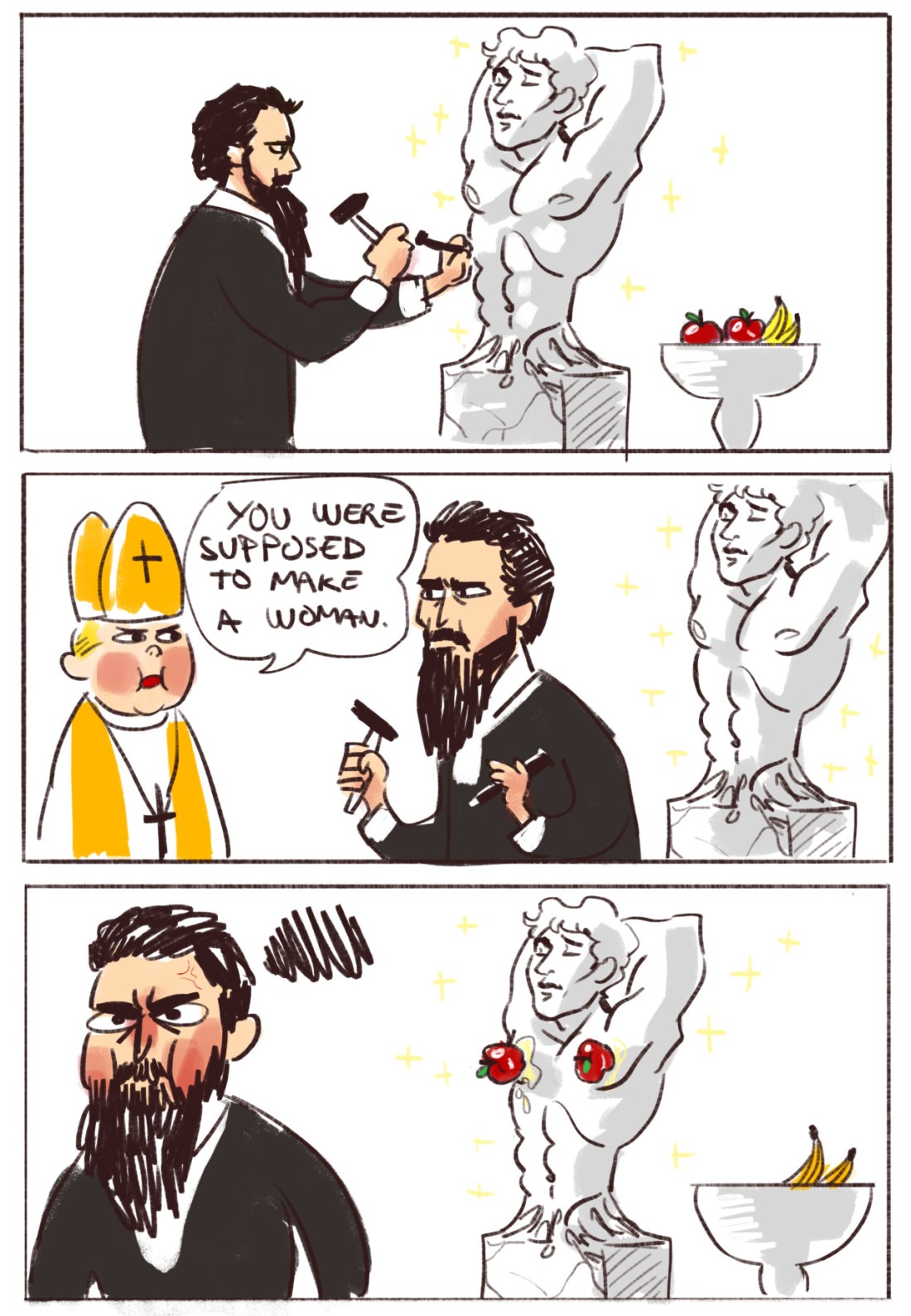
do you ever think about how little Michelangelo cared
All right, everyone, grab a chair and sit back because I’m going to share with you what I learned about Michelangelo and the Sistine Chapel in my Art History Class.
The man NEVER wanted to paint the damn thing. But the pope at the time “forced him to” According to my teacher. Michelangelo hated this man, I MEAN REALLY HATED HIM. So did a majority of people. The pope’s nickname translated literally means “Terrible pope”.
And the working conditions were awful. He had to work on his back with all that paint, which is filled with some toxic shit that gave Michelangelo a limp for the rest of his life. (Also, our teacher made us get on our backs and try drawing with both hands JUST to prove how bad and uncomfortable it is.)
At the time, the ceiling was so high, you could barely see it. You need binoculars to get a good look at what’s up there, by the time people could see the paintings, there was a lot of weird symbolism that Michelangelo hid up there.
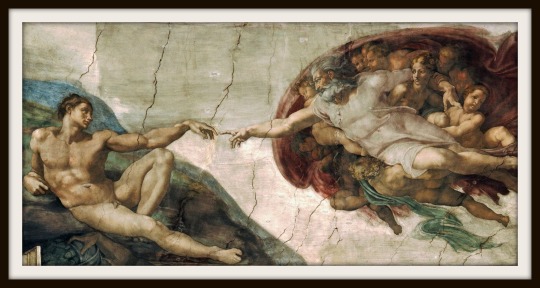
This one? The creation of the sun and moon? God is mooning you. And the pope and all others after him prayed under that without knowing.
This one? At the time, dissecting was sacrilegious and everyone found out how behind God was what looked like half a brain. blah blah, science, science, that pissed everyone off.
And also, ALLLLLLL the men and women in the Sistine Chapel are all on fucking steroids. My teacher described the women’s bodies as “Men bodies with boobs slapped on.”
And then there is this:
Now this is the back wall. Michelangelo actually wanted to paint this one after he finished the ceiling. (and there was a different pope too, I believe.) However, originally, EVERYONE in that painting was naked. And they didn’t like it. Adam and Eve naked? That’s cool. But Jesus? Now you crossed the line. So the pope at the time hired someone else to censor it and give the important figures clothes. He worked on it for 6 or 9 months before he died.
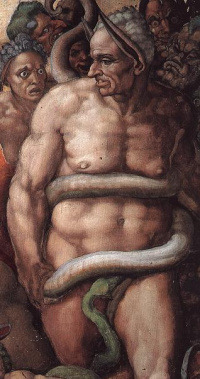
And then the symbolism in this one is great. Somewhere in the right, there are homosexuals in heaven. (No matter what, the Vatican will say “Those straight men are happy” I’ll get to that in a second), Michelangelo painted himself near Jesus, and the terrible pope is in hell with a snake biting his balls.
And if you were to point ANY of this out to the Vatican, they will deny all of it and claim Michelangelo was a catholic hero. In fact, when they discovered the symbolism around the 60s or 70s, the guy who told the Vatican was kicked out of the Vatican for life.
TL;DR: Michelangelo hated the pope and made the best “fuck you” of all time.
YO. ALL OF THIS^. Michelangelo was hella grumpy all of the time. It was fantastic.
However, as beautiful as this commentary is, I’m gonna make a little correction. The Pope isn’t the one in hell getting his balls bitten; that guy is actually the Papal Minister of Ceremonies a the time, Biagio de Cesena.
See, when Michelangelo was painting this, as you said, lots of people were uncomfortable with all of the nudity (especially because the Last Judgement [back wall mural] was painted much later when nudity in religious art was even more controversial than before), but the dude who was the angriest was de Cesena.
He was so angry that he reportedly burst in on Michelangelo while he was working (which is already a big no-no because Michelangelo’s requirements for working were mostly “fuck the hell off and leave me alone or else I quit and I will stab you in the eye with my paintbrush/chisel”.). He then proceeds to tell Michelangelo that this fresco is disgusting and obscene and shame on him etc etc. He also referred to it as “i stui di nudi”, which means “A stew of nudes” which is one of the best descriptions of a thing ever, if you ask me.
So Michelangelo, probably on the cusp of homicide is like “Thank you for the notes. Now get the fuck out,” and de Cesena reluctantly does.
Later, he comes to see the finished product and finds that Michelangelo had painted his portrait down in Hell to represent the Minos, King of the Dead. He has the ears of an ass and the above described crotch biting snake:
Upon seeing this and being enraged, de Cesena went to the Pope to demand that it be changed and that Michelangelo be punished. However, the Pope was SO incredibly done dealing with Michelangelo’s snark, tantrums, and general hatred of the world and everyone in it, that he didn’t want to do shit.
The Pope’s response to him was literally to say “As Pope, I have a lot of influence on Earth and up in Heaven, but I have no jurisdiction in Hell. You’re shit out of luck.“
And it stayed.
Michelangelo, grade A artist, snark master, and professional dick.
My art hero right there lol
All of the above reasons are why I love Michelangelo with a passion.
I don’t know who first spelled the name as “Guinevere,” but I’m forever thankful that it’s the form in most common use, because other options include “Guanhumara” “Guennuuar” “Gahunmare” and “Wenneuereia”
thanks to whichever medieval person decided it was time to stop calling the queen by random horse noises
Harry Truman was inaugurated as U.S. president after being elected in 1948 to his own term; previously he was sworn in following the death of Franklin D. Roosevelt. He authorized the use of atomic bombs on Hiroshima and Nagasaki in Japan during World War II, on August 6 and August 9, 1945, respectively.
Doris Day enters the public spotlight with the films My Dream Is Yours and It’s a Great Feeling as well as popular songs like “It’s Magic”; divorces her second husband.
Red China: The Communist Party of China wins the Chinese Civil War, establishing the People’s Republic of China.
Johnnie Ray signs his first recording contract with Okeh Records, although he would not become popular for another two years.
South Pacific, the prize-winning musical, opens on Broadway on April 7.
Walter Winchell is an aggressive radio and newspaper journalist credited with inventing the gossip column.
Joe DiMaggio and the New York Yankees go to the World Series five times in the 1940s, winning four of them.
1950
Joe McCarthy, the US Senator, gains national attention and begins his anti-communist crusade with his Lincoln Day speech.
Richard Nixon is first elected to the United States Senate.
Studebaker, a popular car company, begins its financial downfall.
Television is becoming widespread throughout Europe and North America.
North Korea and South Korea declare war after Northern forces stream south on June 25.
Marilyn Monroe soars in popularity with five new movies, including The Asphalt Jungle and All About Eve, and attempts suicide after the death of friend Johnny Hyde who asked to marry her several times, but she refused respectfully. Monroe would later (1954) be married for a brief time to Joe DiMaggio (mentioned in the previous verse).
1951
The Rosenbergs, Ethel and Julius, were convicted on March 29 for espionage.
H-Bomb is in the middle of its development as a nuclear weapon, announced in early 1950 and first tested in late 1952.
Sugar Ray Robinson, a champion welterweight boxer.
Panmunjom, the border village in Korea, is the location of truce talks between the parties of the Korean War.
Marlon Brando is nominated for the Academy Award for Best Actor for his role in A Streetcar Named Desire.
The King and I, musical, opens on Broadway on March 29.
The Catcher in the Rye, a controversial novel by J. D. Salinger, is published.
1952
Dwight D. Eisenhower is first elected as U.S. president, winning by a landslide margin of 442 to 89 electoral votes.
The vaccine for polio is privately tested by Jonas Salk.
England’s got a new queen: Queen Elizabeth II succeeds to the throne upon the death of her father, George VI, and is crowned the next year.
Rocky Marciano defeats Jersey Joe Walcott, becoming the world Heavyweight champion.
Liberace has a popular 1950s television show for his musical entertainment.
Santayana goodbye: George Santayana, philosopher, essayist, poet, and novelist, dies on September 26.
1953
Joseph Stalin dies on March 5, yielding his position as leader of the Soviet Union.
Georgy Maksimilianovich Malenkov succeeds Stalin for six months following his death. Malenkov had presided over Stalin’s purges of party “enemies”, but would be spared a similar fate by Nikita Khrushchev mentioned later in verse.
Gamal Abdel Nasser acts as the true power behind the new Egyptian nation as Muhammad Naguib’s minister of the interior.
Sergei Prokofiev, the composer, dies on March 5, the same day as Stalin.
Winthrop Rockefeller and his wife Barbara are involved in a highly publicized divorce, culminating in 1954 with a record-breaking $5.5 million settlement.[12]
Roy Campanella, an African-American baseball catcher for the Brooklyn Dodgers, receives the National League’s Most Valuable Player award for the second time.
Communist bloc is a group of communist nations dominated by the Soviet Union at this time. Probably a reference to the Uprising of 1953 in East Germany.
1954
Roy Cohn resigns as Joseph McCarthy’s chief counsel and enters private practice with the fall of McCarthy. He also worked to prosecute the Rosenbergs, mentioned earlier.
Juan Perón spends his last full year as President of Argentina before a September 1955 coup.
Arturo Toscanini is at the height of his fame as a conductor, performing regularly with the NBC Symphony Orchestra on national radio.
Dacron is an early artificial fiber made from the same plastic as polyester.
Dien Bien Phu falls. A village in North Vietnam falls to Viet Minh forces under Vo Nguyen Giap, leading to the creation of North Vietnam and South Vietnam as separate states.
“Rock Around the Clock” is a hit single released by Bill Haley & His Comets in May, spurring worldwide interest in rock and roll music.
1955
Albert Einstein dies on April 18 at the age of 76.
James Dean achieves success with East of Eden and Rebel Without a Cause, gets nominated for an Academy Award for Best Actor, and dies in a car accident on September 30 at the age of 24.
Brooklyn’s got a winning team: The Brooklyn Dodgers win the World Series for the only time before their move to Los Angeles.
Davy Crockett is a Disney television miniseries about the legendary frontiersman of the same name. The show was a huge hit with young boys and inspired a short-lived “coonskin cap” craze.
Peter Pan is broadcast on TV live and in color from the 1954 version of the stage musical starring Mary Martin on March 7. Disney released an animated version the previous year.
Elvis Presley signs with RCA Records on November 21, beginning his pop career.
Disneyland opens on July 17, 1955 as Walt Disney’s first theme park.
1956
Brigitte Bardot appears in her first mainstream film And God Created Woman and establishes an international reputation as a French “sex kitten”.
Budapest is the capital city of Hungary and site of the 1956 Hungarian Revolution.
Alabama is the site of the Montgomery Bus Boycott which ultimately led to the removal of the last race laws in the USA. Rosa Parks and Martin Luther King, Jr figure prominently.
Nikita Khrushchev makes his famous Secret Speech denouncing Stalin’s “cult of personality” on February 25.
Princess Grace Kelly releases her last film, High Society, and marries Prince Rainier III of Monaco.
Peyton Place, the best-selling novel by Grace Metalious, is published. Though mild compared to today’s prime time, it shocked the reserved values of the 1950s.
Trouble in the Suez: The Suez Crisis boils as Egypt nationalizes the Suez Canal on October 29.
1957
Little Rock, Arkansas is the site of an anti-integration standoff, as Governor Orval Faubus stops the Little Rock Nine from attending Little Rock Central High School and President Dwight D. Eisenhower deploys the 101st Airborne Division to counteract him.
Boris Pasternak, the Russian author, publishes his famous novel Doctor Zhivago.
Mickey Mantle is in the middle of his career as a famous New York Yankees outfielder and American League All-Star for the sixth year in a row.
Jack Kerouac publishes his first novel in seven years, On the Road.
Sputnik becomes the first artificial satellite, launched by the Soviet Union on October 4, marking the start of the space race.
Chou En-Lai, Premier of the People’s Republic of China, survives an assassination attempt on the charter airliner Kashmir Princess.
Bridge on the River Kwai is released as a film adaptation of the 1954 novel and receives seven Academy Awards, including Best Picture.[13]
1958
Lebanon is engulfed in a political and religious crisis that eventually involves U.S. intervention.
Charles de Gaulle is elected first president of the French Fifth Republic following the Algerian Crisis.
California baseball begins as the Brooklyn Dodgers and New York Giants move to California and become the Los Angeles Dodgers and San Francisco Giants. They are the first major league teams west of Kansas City.
Charles StarkweatherHomicide captures the attention of Americans, in which he kills eleven people between January 25 and 29 before being caught in a massive manhunt in Douglas, Wyoming.
Children of Thalidomide: Mothers taking the drug Thalidomide had children born with congenital birth defects caused by the sleeping aid and antiemetic, which was also used at times to treat morning sickness.
1959
Buddy Holly dies in a plane crash on February 3 with Ritchie Valens and The Big Bopper, in a day that had a devastating impact on the country and youth culture. Joel prefaces the lyric with a Holly signature vocal hiccup: “Uh-huh, uh-huh.”
Ben-Hur, a film based around the New Testament starring Charlton Heston, wins eleven Academy Awards, including Best Picture.
Space Monkey: Able and Miss Baker return to Earth from space aboard the flight Jupiter AM-18.
The Mafia are the center of attention for the FBI and public attention builds to this organized crime society with a historically Sicilian-American origin.
Hula hoops reach 100 million in sales as the latest toy fad.
Fidel Castro comes to power after a revolution in Cuba and visits the United States later that year on an unofficial twelve-day tour.
Edsel is a no-go: Production of this car marque ends after only three years due to poor sales.
1960
U-2: An American U-2 spy plane piloted by Francis Gary Powers was shot down over the Soviet Union, causing the U-2 Crisis of 1960.
Syngman Rhee was rescued by the CIA after being forced to resign as leader of South Korea for allegedly fixing an election and embezzling more than US $20 million.
Payola, illegal payments for radio broadcasting of songs, was publicized due to Dick Clark’s testimony before Congress and Alan Freed’s public disgrace.
John F. Kennedy beats Richard Nixon in the November 8 general election.
Chubby Checker popularizes the dance The Twist with his cover of the song of the same name.
Psycho: An Alfred Hitchcock thriller, based on a pulp novel by Robert Bloch and adapted by Joseph Stefano, which becomes a landmark in graphic violence and cinema sensationalism. The screeching violins heard briefly in the background of the song are a trademark of the film’s soundtrack.
Belgians in the Congo: The Republic of the Congo (Leopoldville) was declared independent of Belgium on June 30, with Joseph Kasavubu as President and Patrice Lumumba as Prime Minister.
1961
Ernest Hemingway commits suicide on July 2 after a long battle with depression.
Adolf Eichmann, a “most wanted” Nazi war criminal, is traced to Argentina and captured by Mossad agents. He is covertly taken to Israel where he is put on trial for crimes against humanityin Germany during World War II, convicted, and hanged.
Stranger in a Strange Land, written by Robert A. Heinlein, is a breakthrough best-seller with themes of sexual freedom and liberation.
Bob Dylan is signed to Columbia Records after a New York Times review by critic Robert Shelton.
Berlin is separated into West Berlin and East Berlin, and from the rest of East Germany, when the Berlin Wall is erected on August 13 to prevent citizens escaping to the West.
The Bay of Pigs Invasion fails, an attempt by United States-trained Cuban exiles to invade Cuba and overthrow Fidel Castro.
1962
Lawrence of Arabia: The Academy Award-winning film based on the life of T. E. Lawrence starring Peter O’Toole premieres in America on December 16.
British Beatlemania: The Beatles, a British rock group, gain Ringo Starr as drummer and Brian Epstein as manager, and join the EMI’s Parlophone label. They soon become the world’s most famous rock band, with the word “Beatlemania” adopted by the press for their fans’ unprecedented enthusiasm. It also began the British Invasion in the United States.
Ole’ Miss: James Meredith integrates the University of Mississippi
John Glenn: Flew the first American manned orbital mission termed “Friendship 7” on February 20.
Liston beats Patterson: Sonny Liston and Floyd Patterson fight for the world heavyweight championship on September 25, ending in a first-round knockout. This match marked the first time Patterson had ever been knocked out and one of only eight losses in his 20-year professional career.
1963
Pope Paul VI: Cardinal Giovanni Montini is elected to the papacy and takes the papal name of Paul VI.
Malcolm X makes his infamous statement “The chickens have come home to roost” about the Kennedy assassination, thus causing the Nation of Islam to censor him.
British politician sex: The British Secretary of State for War, John Profumo, has a relationship with a showgirl, and then lies when questioned about it before the House of Commons. When the truth came out, it led to his own resignation and undermined the credibility of the Prime Minister.
JFK blown away: President John F. Kennedy is assassinated on November 22 while riding in an open convertible through Dallas.
1965
Birth control: In the early 1960s, oral contraceptives, popularly known as “the pill”, first go on the market and are extremely popular. Griswold v. Connecticut in 1965 challenged a Connecticut law prohibiting contraceptives. In 1968, Pope Paul VI released a papal encyclical entitled Humanae Vitae which declared artificial birth control a sin.
Ho Chi Minh: A Vietnamese communist, who served as President of Vietnam from 1954–1969. March 2 Operation Rolling Thunder begins bombing of the Ho Chi Minh Trail supply line from North Vietnam to the Vietcong rebels in the south. On March 8, the first U.S. combat troops, 3,500 marines, land in South Vietnam.
1968
Richard Nixon back again: Former Vice President Nixon is elected President in 1968.
1969
Moonshot: Apollo 11, the first manned lunar landing, successfully lands on the moon.
Woodstock: Famous rock and roll festival of 1969 that came to be the epitome of the counterculture movement.
1974–75
Watergate: Political scandal that began when the Democratic National Committee’s headquarters at the Watergate office complex in Washington, DC was broken into. After the break-in, word began to spread that President Richard Nixon (a Republican) may have known about the break-in, and tried to cover it up. The scandal would ultimately result in the resignation of President Nixon, and to date, this remains the only time that anyone has ever resigned the United States Presidency.
Punk rock: The Ramones form, with the Sex Pistols following in 1975, bringing in the punk era.
1976–77
(An item from 1977 comes before three items from 1976 to make the song scan.)
Menachem Begin becomes Prime Minister of Israel in 1977 and negotiates the Camp David Accords with Egypt’s president in 1978.
Ronald Reagan was elected President of the United States in 1980, but he first attempted to run for the position in 1976.
Palestine: a United Nations resolution that calls for an independent Palestinian state and to end the Israeli occupation.
Terror on the airline: Numerous aircraft hijackings take place, specifically, the Palestinian hijack of Air France Flight 139 and the subsequent Operation Entebbe in Uganda.
1979
Ayatollah’s in Iran: During the Iranian Revolution of 1979, the West-backed and secular Shah is overthrown as the Ayatollah Ruhollah Khomeini gains power after years in exile and forces Islamic law.
Russians in Afghanistan: Following their move into Afghanistan, Soviet forces fight a ten-year war, from 1979 to 1989.
1983
Wheel of Fortune: A hit television game show which has been TV’s highest-rated syndicated program since 1983.
Sally Ride: In 1983 she becomes the first American woman in space. Ride’s quip from space “Better than an E-ticket”, harkens back to the opening of Disneyland mentioned earlier, with the E-ticket purchase needed for the best rides.
Heavy metal suicide: In the 1980s Ozzy Osbourne and the bands Judas Priest and Metallica were brought to court by parents who accused the musicians of hiding subliminal pro-suicide messages in their music.
Foreign debts: Persistent U.S. trade deficits
Homeless vets: Veterans of the Vietnam War, including many disabled ex-military, are reported to be left homeless and impoverished.
AIDS: A collection of symptoms and infections in humans resulting from the specific damage to the immune system caused by infection with the human immunodeficiency virus (HIV). It is first detected and recognized in the 1980s, and was on its way to becoming a pandemic.
Crack cocaine use surged in the mid-to-late 1980s.
1984
Bernie Goetz: On December 22, Goetz shot four young men who he said were threatening him on a New York City subway. Goetz was charged with attempted murder but was acquitted of the charges, though convicted of carrying an unlicensed gun.
1988
Hypodermics on the shore: Medical waste was found washed up on beaches in New Jersey after being illegally dumped at sea. Before this event, waste dumped in the oceans was an “out of sight, out of mind” affair. This has been cited as one of the crucial turning points in popular opinion on environmentalism.
1989
China’s under martial law: On May 20, China declares martial law, enabling them to use force of arms against protesting students to end the Tiananmen Square protests.
Rock-and-roller cola wars: Soft drink giants Coke and Pepsi each run marketing campaigns using rock & roll and popular music stars to reach the teenage and young adult demographic.
Short summaries of all 119 references mentioned in the song, you’re welcome






 ¯_( ಠ_ಠ)_/¯