Maybe this is over-simplifying the first “part” of Les Mis, but the tragedy of Javert, Valjean and Fantine is the impossiblity of returning to society after something “wrong” they did (being born as a child of criminals, stealing for desperation, having a child without being married) and it unfolds as each of them deals with it in their personal way.
Fantine works hard but the ongly thing she gets is being ostracized more and more, and this eventually makes her bitter and angry as she starts the good in people.
Javert arrests her, having chosen the supposed “right” way of being a pariah (aka being a policeman: outside of society, but protecting it) and being unable to understand why others can’t make his own choice.
Valjean is forced to assume a false identiti, and identifies with her, because he too had become bitter and angry, but is unable to help her in the end because another poor old man is risking to pay for the crimes he committed years ago (and still, society cannot forgive Valjean; had he not intervened, Champmathieu would have risked death penalty).
So, yeah, they all break my heart.
They’re ostracized from society and it takes away their identity and their humanity (I love the line from the musical “they gave me a number and murdered Valjean”). They’re all reduced to these roles and stereotypes, not seen as real people anymore.
Jean Vajean slowly regains his humanity and remakes himself through religion and loving Cosette, finding his path to redemption. Javert, when finally faced with his own humanity, has a moment of clarity he can’t deal with and kills himself. Fantine, while dehumanized, always maintained her role as self-sacrificing mother, and in her final days she at last is respected as a person again and allowed to rest and have peace.
I love how they all deal with their outsider status in different ways. Society is the true villain of Les Mis, and Victor Hugo shows so many ways it impacts these characters.
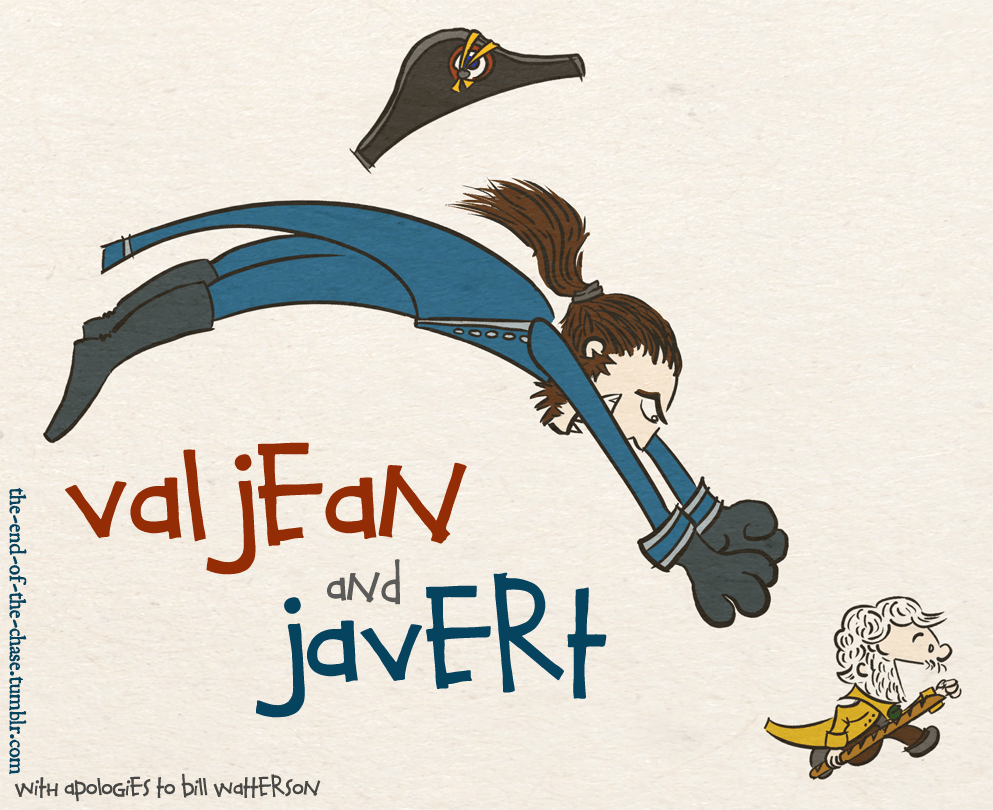
Draft in Krita of a future watercolour project. Need to develop more contrast in the line weight, among other tweaks, but still quite pleased with this. 🙂
He, Javert, personified justice, light, and truth in their celestial function of crushing out evil. Behind him and around him, at an infinite distance, he had authority, reason, the case judged, the legal conscience, the public prosecution, all the stars; he was protecting order, he was causing the law to yield up its thunders, he was avenging society, he was lending a helping hand to the absolute, he was standing erect in the midst of a glory. There existed in his victory a remnant of defiance and of combat. Erect, haughty, brilliant, he flaunted abroad in open day the superhuman bestiality of a ferocious archangel. The terrible shadow of the action which he was accomplishing caused the vague flash of the social sword to be visible in his clenched fist; happy and indignant, he held his heel upon crime, vice, rebellion, perdition, hell; he was radiant, he exterminated, he smiled, and there was an incontestable grandeur in this monstrous Saint Michael – Victor Hugo (Les Misérables).











 ¯_( ಠ_ಠ)_/¯