Throwback to the time my poor German teacher had to explain the concept of formal and informal pronouns to a class full of Australians and everyone was scandalised and loudly complained “why can’t I treat everyone the same?” “I don’t want to be a Sie!” “but being friendly is respectful!” “wouldn’t using ‘du’ just show I like them?” until one guy conceded “I suppose maybe I’d use Sie with someone like the prime minister, if he weren’t such a cunt” and my teacher ended up with her head in her hands saying “you are all banned from using du until I can trust you”
God help Japanese teachers in Australia.
if this isnt an accurate representation of australia idk what is
Australia’s reverse-formality respect culture is fascinating. We don’t even really think about it until we try to communicate or learn about another culture and the rules that are pretty standard for most of the world just feel so wrong. I went to America this one time and I kept automatically thinking that strangers using ‘sir’ and ‘ma’am’ were sassing me.
Australians could not be trusted with a language with ingrained tiers of formal address. The most formal forms would immediately become synonyms for ‘go fuck yourself’ and if you weren’t using the most informal version possible within three sentences of meeting someone they’d take it to mean you hated them.
100% true.
the difference between “‘scuse me” and “excuse me” is a fistfight
See also: the Australian habit of insulting people by way of showing affection, which other English-speakers also do, but not in a context where deescalating the spoken invective actively increases the degree of offence intended, particularly if you’ve just been affectionately-insulting with someone else.
By which I mean: if you’ve just called your best mate an absolute dickhead, you can’t then call a hated politician something that’s (technically) worse, like a total fuckwit, because that would imply either that you were really insulting your mate or that you like the politician. Instead, you have to use a milder epithet, like bastard, to convey your seething hatred for the second person. But if your opening conversational gambit is slagging someone off, then it’s acceptable to go big (”The PM’s a total cockstain!”) at the outset.
Also note that different modifiers radically change the meaning of particular insults. Case in point: calling someone a fuckin’ cunt is a deadly insult, calling someone a mad cunt is a compliment, and calling someone a fuckin’ mad cunt means you’re literally in awe of them. Because STRAYA.
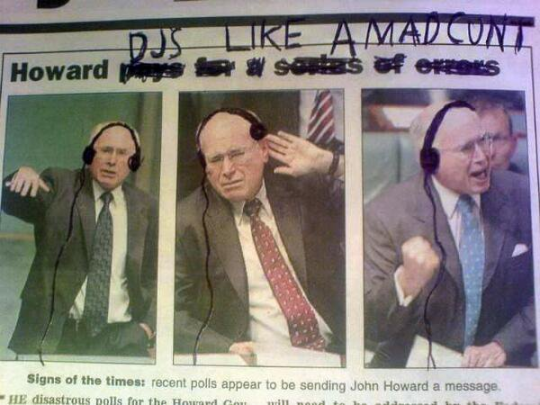
case in point: the ‘Howard DJs like a mad cunt’ meme.
1. I work for the Australian National Audit Office as a federal performance analyst and literally everyone in the office refers to each other by their first name. Even the Auditor-General gets called by his first name, and he’s an independent officer of the Parliament, appointed by the
Governor-General on the recommendation of the Joint Committee of Public
Accounts and Audit (JCPAA) and the Prime Minister.
2. This is like the fourth time I’ve reblogged this due to additional A+ commentary.
Legolas pretty quickly gets in the habit of venting about his travelling companions in Elvish, so long as Gandalf & Aragorn aren’t in earshot they’ll never know right?
Then about a week into their journey like
Legolas: *in Elvish, for approximately the 20th time* ugh fucking hobbits, so annoying
Frodo: *also in Elvish, deadpan* yeah we’re the worst
Legolas:
~*~earlier~*~
Legolas: ugh fucking hobbits
Merry: Frodo what’d he say
Frodo: I’m not sure he speaks a weird dialect but I think he’s insulting us. I should tell him I can understand Elvish
i mean, honestly it’s amazing the Elves had as many languages and dialects as they did, considering Galadriel (for example) is over seven thousand years old.
english would probably have changed less since Chaucer’s time, if a lot of our cultural leaders from the thirteenth century were still alive and running things.
they’ve had like. seven generations since the sun happened, max.
frodo’s books are old to him, but outside any very old poetry copied down exactly, the dialect represented in them isn’t likely to be older than the Second Age, wherein Aragorn’s foster-father Elrond started out as a very young adult and grew into himself, and Legolas’ father was born.
so like, three to six thousand years old, maybe, which is probably a drop in the bucket of Elvish history judging by all the ethnic differentiation that had time to develop before Ungoliant came along, even if we can’t really tell because there weren’t years to count, before the Trees were destroyed.
plus a lot of Bilbo’s materials were probably directly from Elrond, whose library dates largely from the Third Age, probably, because he didn’t establish Imladris until after the Last Alliance. and Elrond isn’t the type to intentionally help Bilbo learn the wrong dialect and sound sillier than can be helped, even if everyone was humoring him more than a little.
so Frodo might sound hilariously formal for conversational use (though considering how most Elves use Westron he’s probably safe there) and kind of old-fashioned, but he’s not in any danger of being incomprehensible, because elves live on such a ridiculous timescale.
to over-analyse this awesome and hilarious post even more, legolas’ grandfather
was from linguistically stubborn Doriath and their family is actually from a
somewhat different, higher-status ethnic background than their subjects.
so depending on how much of a role Thranduil took in his
upbringing (and Oropher in his), Legolas may have some weird stilted old-fashioned speaking tics in his
Sindarin that reflect a more purely Doriathrin dialect rather than the Doriathrin-influenced Western Sindarin that became the most widely spoken Sindarin long before he was born, or he might have a School Voice
from having been taught how to Speak Proper and then lapse into really
obscure colloquial Avari dialect when he’s being casual. or both!
considering legolas’ moderately complicated political position, i expect he can code-switch.
…it’s
also fairly likely considering the linguistic politics involved that Legolas is reasonably articulate in Sindarin, though
with some level of accent, but knows approximately zero Quenya outside of loanwords into Sindarin, and even those he mostly didn’t learn as a kid.
which would be extra hilarious when he and gimli fetch up in Valinor in his little homemade skiff, if the first elves he meets have never been to Middle Earth and they’re just standing there on the beach reduced to miming about what is the short beard person, and who are you, and why.
this is elvish dialects and tolkien, okay. there’s a lot of canon material! he actually initially developed the history of middle-earth specifically to ground the linguistic development of the various Elvish languages!
Legolas: Alas, verily would I have dispatched thine enemy posthaste, but y’all’d’ve pitched a feckin’ fit.
Aragorn: *eyelid twitching*
Frodo: *frantically scribbling* Hang on which language are you even speaking right now
Pippin, confused: Is he not speaking Elvish?
Frodo, sarcastically: I dunno, are you speaking Hobbit?
Boromir, who has been lowkey pissed-off at the Hobbits’ weird dialect this whole time: That’s what it sounds like to me.
Merry, who actually knows some shit about Hobbit background: We are actually speaking multiple variants of the Shire dialect of Westron, you ignorant fuck.
Sam, a mere working-class country boy: Honestly y’all could be talkin Dwarvish half the time for all I know.
Pippin, entering Gondor and speaking to the castle steward: hey yo my man
Honestly, as a German I can not quite understand the obsession of the English speaking world with the question whether a word exists or not. If you have to express something for which there is no word, you have to make a new one, preferably by combining well-known words, and in the very same moment it starts to exist. Agree?
Deutsche Freunde, could you please create for me a word for the extreme depression I feel when I bend down to pick up a piece of litter and discover two more pieces of litter?
um = around
die Welt = world
die Umwelt = environment
ver = prefix to indicate something difficult or negative, a change that leads to deterioration or even destruction that is difficult to reverse or to undo, or a strong negative change of the mental state of a person
der Müll = garbage, trash, rubbish, litter
-ung = -ing
die Vermüllung = littering
ver- = see before
zweifeln = to doubt
-ung = see before
die Verzweiflung = despair, exasperation, desperation
die Umweltvermüllungsverzweiflung = …
This is a german compound on the spot master class and I am LIVING
aragorn: a relatively neutral rivendell accént. first learned from hanging out with elladan and elrohir so it’s kind of vulgar some of the time because they’re uhhhhhhhhhhhh teenagers
elrond slams the door shut and whirls around to face his children. “who taught aragorn how to say fuck?” he demands.
arwen and the twins eye each other suspiciously because it honestly could have been any one of them
legolas: my url speaks for itself. he’s howdy at best and completely unintelligible at worst.
“how are you today?” frodo asks
“i’m finer’n frog hair split four ways,” legolas says, baring his teeth in a smile
“why can’t you just speak to me in normal elvish like a normal person,” frodo asks, ripping up his a-z elvish dictionary
galadriel: an absolutely disgusting lothlórien accent
thinking in your target language: coherent and eloquent sentences. you use every verb tense perfectly, the grammatical genders are all correct, and your intonation is like a native speaker’s.



 ¯_( ಠ_ಠ)_/¯