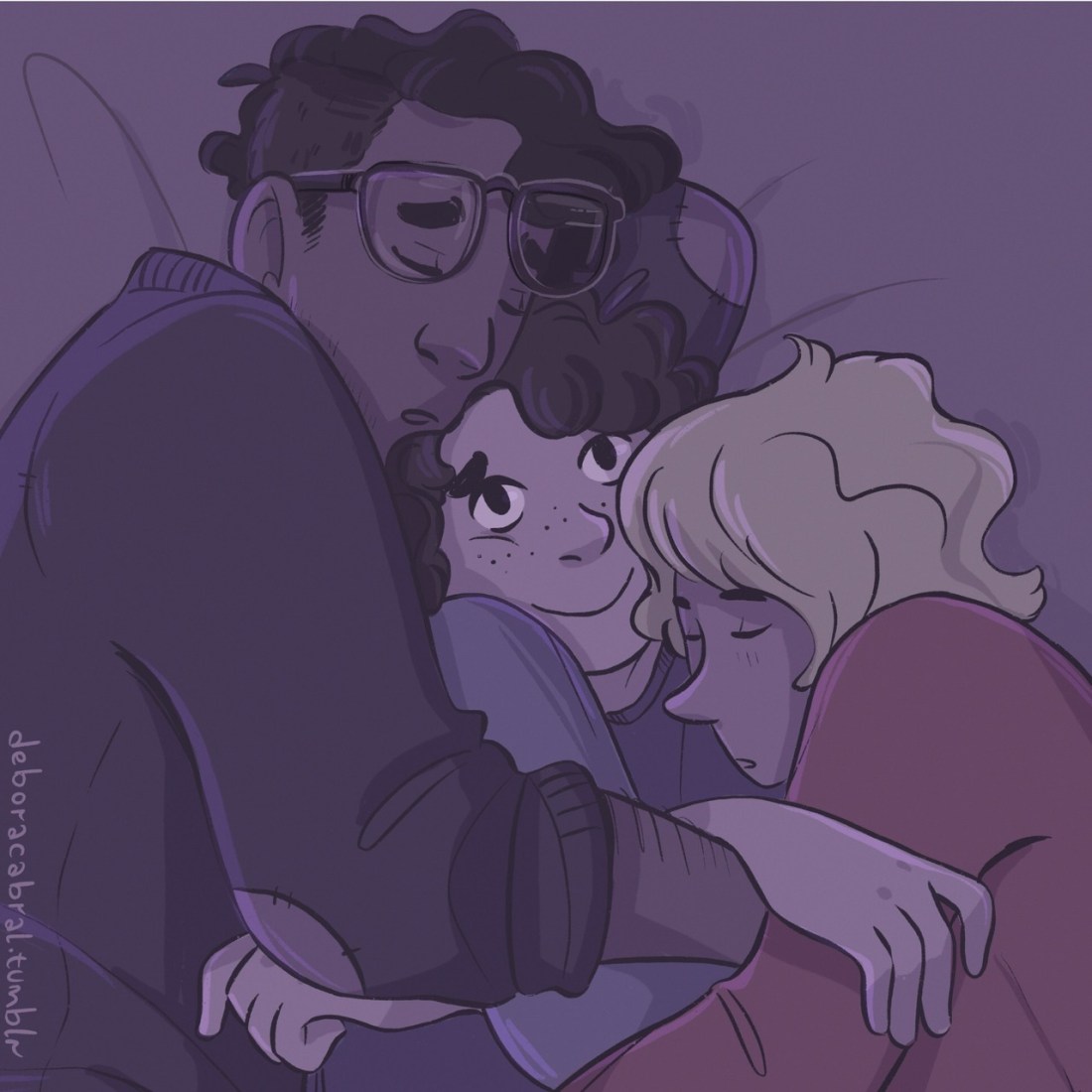
Why is that the les mis fandom likes to think “big and dark-skinned=ugly” and “small and pale=beautiful” when in respect to grantaire and enjolras? why is enjolras this dainty little flower with white as fuck features while grantaire is a big, hulking man with features common to people of color? thats chock full of racist connotations that needs to be broken down and instead, indulge in the idea that enjolras is a muscular body builder (hey, the cars arent gonna turn themselves over in a riot) and can only shop exclusively in the big in tall section, and gives his tiny boyfriend grantaire piggyback rides too and from his work.
I’ve noticed that a lot of people will do the whole ‘everyone is beautiful, ugliness doesn’t exist!!! Enjolras loves him the way he is!’ type thing but then, without fail, all talk about how Grantaire is ugly because he has a large nose, deep-set eyes and large lips. I’m totally cool with small feminine Enj (white, albino or Melanesian because he’s a natural blond) because of all the canon ‘he looks like a girl’ stuff but like… Maybe don’t say Grantaire is ugly because he has typical Jewish or black features, you know? No, saying his nose has been broken before doesn’t somehow negate the racism. I saw one person say he was ugly because of his dark body hair and olive skin tone and that sure was a thing I had to read with my actual eyes :)) you totally aren’t implying that the native populations of several European countries are ugly because they don’t have the whole Nordic thing going on.
Y’all, if this post makes you uncomfortable, it is even more important to reblog it. I almost didn’t because I was like “o shit… I’ve done that in fic” but you know what? Discomfort about something you’ve done in the past/are still doing is a good thing because it means you’re ready for growth. No one is attacking anyone else here, no one has to pretend to be blameless. Admit to your mistakes because you can’t fix them if you aren’t aware of them. We’re all growing together
ok so i saw les mis again on wednesday and it got me thinking.
nearly every song in the show is either directly reprised or at least uses a repeating melody from other songs in the show. i say nearly; there are two exceptions* whose melodies are never sung in another song: stars and dog eat dog. interestingly enough, these two are also the closest the show has to “””villain songs.”””
they’re absolutely not villain songs. especially not stars. but i digress.
the songs that do repeat are sung mostly by the “redeemable” characters (javert and thenardier are the closest thing the story has to villains, though they are both still victims of society like everyone else and included as a part of “the miserable ones”), and those songs connect characters to others, both in the literal sense of their melodies getting sung by others in kind of a web and in the sense of the characters actually interacting within the songs. madame thenardier sings exclusively in repeating/reprised songs, which seems like it could be a subversion of that EXCEPT the thing about madame t is that (this is more of a thing in the book but it does Kind Of touch on this in the show) she’s cruel and horrible to most people, especially cosette, but she has one redeeming quality in that she genuinely, truly, loves her daughters azelma and eponine, which connects her to other people.
the two songs that are completely independent are pretty defining songs for both thenardier and javert (as in like. the biggest insight to their true personalities, as it’s javert’s only independent song when he’s in a sane state of mind/before he has a moral epiphany and it’s thenardier’s only song where he’s alone and also his only totally serious song).
i will maintain until i die that stars shows javert in a sympathetic light, bc it shows how convinced he is that he’s doing the right thing, and it should be played as a soft song, but it still shows how cold and single minded javert can be, and how he doesn’t really care for other people, he just knows what’s Right and that means he has to get valjean because valjean is a criminal and once someone has committed a crime they can never reform.
dog eat dog is kind of horrifying because it shows thenardier’s nihilism and total lack of humanity; he talks abt how god is dead while robbing the dead bodies in the sewers, but even that i can argue is kind of showing at least. not any kind of sympathy for thenardier’s actions but like, an explanation for them. in master of the house what we get in terms of his characterization is more like “haha he’s awful, he just steals from people For The Lols,” but dog eat dog shows how he’s motivated by his “kill or be killed” mentality and the fact that he feels like god has never helped him; he’s had such a shitty life and no one who has cared for him or provided for him, so who cares about morality. it’s all the same when everyone who has beliefs, or convictions, or affection for other people ends up dead in the sewers because of it.
so both stars and dog eat dog show why javert and thenardier are like… the way they are, and even tho javert acts completely guided by the law and thenardier acts with no regard for it, both songs show how much they’ve isolated themselves, how disconnected from others they are. in turn, the songs themselves are isolated within the show, which, in a show with as much repetition and reprise as les mis, is notable. javert and thenardier are the only characters who are completely without positive connections, without empathy, and both the content and the context of their songs reflects that.
but.
even though no other song contains lyrics sung to the melody of stars, we do hear it again. once. it’s repeated instrumentally immediately following javert’s suicide; the haunting, miserable song leading up to the jump (which is an EXTREMELY close reprise of valjean’s soliloquy) is followed by a few notes of the more hopeful, softer stars. in this, i see absolution. javert lived with no regard for others, isolated because of his rigid black-and-white morality and his blindness to others’ suffering, but he died seeing, finally, the gray area, recognizing valjean’s inherent goodness despite his criminal past, and choosing to die instead of arresting him. in doing so, javert ensures valjean’s freedom, in a sense; he is the only person in the world who knows valjean’s past and his real identity, and if valjean had chosen to guard the information, any danger relating to it would have died with him. javert is disturbed, he can’t reconcile valjean being good with everything he’s thought about him for years, and for the first time, he’s questioning (and horrified at) the implications of this realization; if valjean can be good, could that mean that javert has been making the wrong decisions for years, putting the wrong people behind bars? in his last moments, he finds nothing but anguish, but for the smallest second, he’s let other people in. he understands jean valjean. in a way, he saves valjean, if only from himself. i think it’s no coincidence that javert’s first solo song is totally isolated, but this one perfectly mirrors a song valjean sings; both valjean’s soliloquy and javert’s suicide represent a moment of mental turmoil for the characters after being saved by a man whom he has actively hurt, and, just as the bishop’s action restore human connection to valjean, valjean’s action restores human connection to javert. those few seconds of stars’ melody reflect that, at the very end, javert has changed, and understands how to care for other people. that understanding after a life of isolation destroys him, but in a way, he dies redeemed.
which is kind of spat on by productions that don’t put him in the finale but whatever i guess
thenardier has no such moment. dog eat dog is the one completely, totally isolated song in the show; there is not a hint of its tune anywhere else, because thenardier never changes. he won’t. in the face of the horrors of the barricade, the death of both his daughter and his son among the revolutionaries (though he had abandoned gavroche long before that moment, anyway), and the wretchedness of the sewers, he sees only another opportunity to scrape his way back into wealth, and in his last appearance, he’s just the same as he was when we first saw him (singing the same melody to boot). dog eat dog never references or repeats other songs, and is never referenced or repeated in turn, because when broken down to his bare essentials, thenardier is nothing but a twisted and dirty core, disconnected from every other character and concerned only with himself, and no moral epiphany could change that. like javert, he’s both a victim and a product of society, but javert was at heart idealistic; he thought the world and his actions were just and destroyed himself when he realized that they weren’t. thenardier is defined by his knowledge that society, that the world, that god himself is unjust and never helped or comforted him, and after a lifetime of that belief, nothing can dissuade him. he spends his time on stage utterly alone, and he’ll stay that way until he dies.
*bring him home nearly qualifies; when it’s sung toward the end of the show, it uses no bits from other melodies, and it’s only reprised in valjean’s death, when he sings asking god to let him finally rest. this is, imo, very interesting, because bring him home functions very much like stars and dog eat dog, in that it is an individual song, nearly never reprised, and it’s very character defining for valjean. however, unlike those songs, bring him home very pointedly shows that valjean isn’t like javert and thenardier; he’s really defined by his affection for other people, and isn’t effectively alone in the world like them. but he was. before the bishop, valjean was just as bitter as thenardier is about the world throwing him away, just as singleminded in his worldview as javert. but he changed. he received kindness in digne for the first time in 19 years, and took that to become a different person, to help fantine and save champmathieu and adopt cosette, to free javert, to die loved by his children and blessed by god. bring him home comes late in the play and is nearly not reprised (because valjean was very much like javert and thenardier once!), but in valjean’s death, the melody comes back, because he changed. alright i’m probably pushing it now but. hm.
Enjolras: “I am a terrible driver, I know nothing about cars. I meant to learn about them and then I forgot.”
Combeferre: “On Cold Case Files, they solve old murders, and it’s really interesting ‘ cause what I learned from it is that it was really easy to get away with murder before they knew about DNA.”
Courfeyrac: “Now when people make fun of me, I deserve it.”
Feuilly: “Why do people always shush animals? They’ve never spoken.”
Bahorel: “I wasn’t offended as a boy being confused with a lady, I was offended as a lady who was getting pushed around by this chauvinist asshole that works in blockbuster video talking to me like I was some floozy.”
Jehan: “Everyone get out of my way! I just want to sit here and feed my birds.”
Grantaire: “I quit drinking because I would drink too much and then I’d black out and I would “ruin” parties. Or so I’m told.“
Joly: "All of his jokes were very anti-work, which is not always want you want from a health care professional.”
Bossuet: “When I was in grade school I was bullied for being Asian American. And the biggest problem with that is that I am not Asian American.”
Musichetta: “And I said ‘no.’ You know, like a liar.”
Eponine: “It’s wrong to make fun of people, but it’s so fun.”
Marius: “Before I had a girlfriend I never had someone who’s always standing next to me who can just point out obvious things that are happening.”
Cosette: “Once people start drinking for the night, they forget everything that isn’t alcohol.”










 ¯_( ಠ_ಠ)_/¯
