Hello,
Enjolras is not an asshole.
Thank you for your attention.
LISTEN UP KIDS.
The only time Enj is described as cold and bitchy is 1) when hes described as not being interested in women and 2) when he is dragging Grantaire Explainations: hes gay and grantaire is onpurposely trying to provoke him at ALL TIMES. LIKE OFC THATS GONA PISS HIM OFF.
all the other times he is described as “charming” and a “quiet” man who lets his friends speak and listens. He has a while speech just PRAISING FEUILLY. He cries when he shoots the artillery sgt. He lets Grantaire help when he asks despite not trusting him fully. Even then he lets Grantaire by his side.
!!!!!!!Also!!!!!!!! HIS ENTIRE THING IS THAT HE CARES TOO MUCH. YOU THINK HE IS TRYING TO OVERTHROW THE GOVERNMENT AND RAISE THE PEOPLE FROM POVERTY BECAUSE HES A BITCH?????????? Like his entire thing is that he cares SO MUCH.
Enjolras is soft. I will fight you.
He is neither soft or an asshole: he is a fanatic revolutionary. Which means that his private persona has been subdued by his political one. I don’t think Hugo ever portrayis him as bitchy or really cold: as Saint Just ( his main inspiration), he may look cold but it’s just suppressed energy.
hmm excuse me sweatie :)))
I think you meant fantastic
Dragging people in a riot doomed to fail because badly organized isn’t fantastic. Even if you do it for a Greater Good, which may be admirable on some levels tho
Ah yes. No one else had free will. Only enjolras that manipulative son of a…..
The riot was doomed because its leader were wrong. Free will or not, they knew that they where leading other people to a very probable death. No amount of charme or charisma can change that.
I was going to stay way out of this because I hate discourse, but man you are misinterpreting Enjolras so badly and he deserves so so much more.
Enjolras was not their leader. Canonically and historically, Les Amis was a very small group in a very large mass of secret societies. Even if Enjolras was the leader of just Les Amis, it was never his ultimate decision. They were all part of something much bigger
(also you really think if Enjolras wasn’t their they wouldn’t have just found another group to fight with? Bahorel was going down swinging in EVERY universe). But Enjolras wasn’t even the leader of Les Amis. He was the chief, the one that a lot of the decision-making fell upon (because he was best for the job and most passionate about it 98% of the time), but he was never a leader. He even says so himself when Marius comes to the barricade. Even if others saw him as a leader, Enjolras did not. And we are given so many examples of this throughout the barricade chapters. He takes other peoples advice constantly, especially Combeferre’s. He is considered the chief because he was the most charismatic, most passionate, and most able to garnish results, but he was never technically a leader. This wasn’t a war, he wasn’t a general, this was a riot (in your own words) of the people, and Enjolras was just a person.
He literally encouraged people to leave when things went sour??? He was more than happy to give his life for the cause, but he never expected anybody else to.
The rebellion, both in the book and history, was not doomed from the start. There were so many factors that came into their loss, including the very unexpected brutality from the National Guard. Nobody expected the government to retaliate the way that they did, even historically where a lot of people DID survive the June Rebellion, the National Guard was criticized for the amount of violence they used. Also, judging by the turnout of people at Lamarque’s funeral (which was in the thousands or even tens of thousand, IIRC) who said they would fight, they were expecting a MUCH more even playing field. However, in the book especially, the people failed to back them up. Do you really think they would have gone through with it had they known they were only going to have like 60 men on their barricade? No. Also there were other factors that were either unexpected or miscalculated, including disruptions to ammunition supply lines and even perhaps weather. So no, they didn’t run in on a suicide mission, they genuinely believed they had a shot. And hey, under different circumstances it probably would of.
The boys weren’t new to battle. Even though it is not talked about in the book, it is extremely likely that most, if not all, of them participated in the Rebellion of 1830 which, all things considered, went pretty well for them. This just again re-iterates the fact that everyone did not think the June Rebellion was going to go as badly as it did. Even if Enjolras was forcefully leading them anywhere (which he certainly wasn’t), it’s not like they were expecting to die. Ready for it? Yes. But probably not expecting it.
Enjolras was soft as fuck. He refused to kill Javert with a knife, he didn’t want a little kid on the barricade, he let Courf and Bossuet joke around, he let Combeferre nerd out about artillery, his first reaction when Jehan was captured was ‘trade them for Javert’ (and PLEASE remember that thiings were going alright for them at this stage, and if they had of given Javert back he would have immediately told the National Guard every piece of intel he had. This is canonical proof that Enjolras put his friends before the rebellion), he shot a murder even though he hated it so his friends didn’t have to, he cried when he had to kill a fellow Parisian, he died holding Grantaire’s hand. Enjolras was soft and most, most importantly, Enjolras loved his friends. And that is what makes me so upset about your comment, that you think in any universe Enjolras would put the rebellion before his friends. He wouldn’t and he didn’t. He loved them so so so much, and if you think he wouldn’t have tried to save them if he could you are very wrong, and Enjolras deserves better,
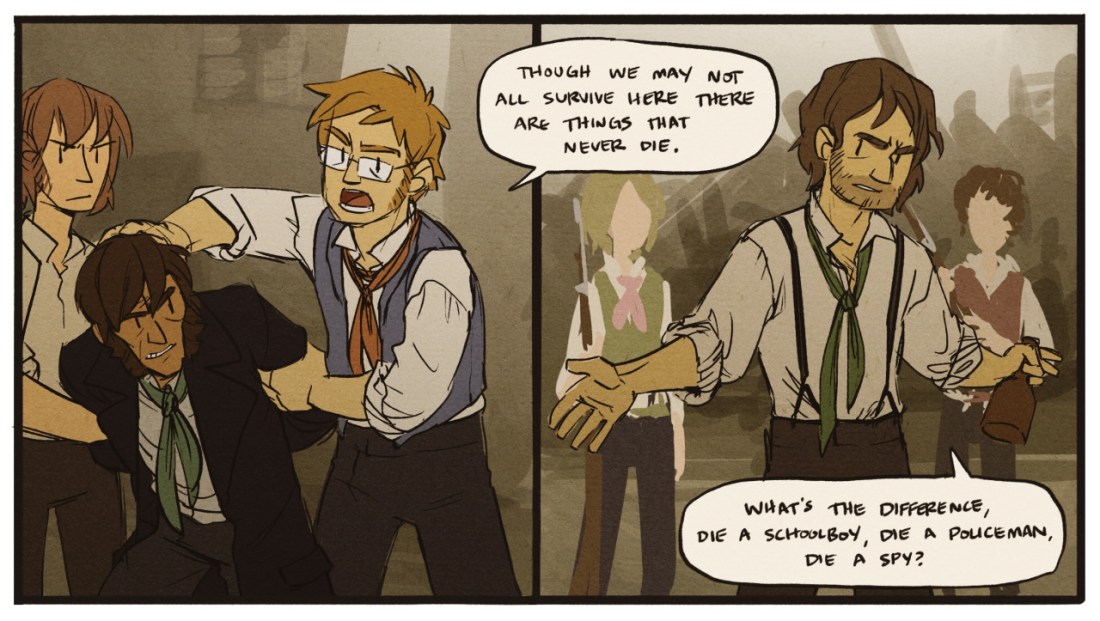
Was it just me or were these lines cut from the current production? Someone with a better memory please reassure/confirm. Either way I felt like drawing it.
screeaaamss yes, the lyrics were cut back in 2000. combeferre used to sing his lines as he stopped the others from pointing their guns at javert, and grantaire was… somewhere
The score is also really interesting here:
The lines sung by Courfeyrac, Feuilly, and Bossuet, when threatening Javert (take the bastard now and shoot him/let us watch this devil dance/you would do the same Inspector/if we let you have your chance) are to a line of music that is elsewhere only seen in two places: it is usually sung by Javert when he is pronouncing judgment on other characters; for example, it is the tune to which I have heard such protestations/every day for twenty years/let’s have no more explanations/save your breath and save your tears is sung during Fantine’s Arrest. The only other time it is used is when Gavroche is mocking Javert. The musical cues, therefore, tell us that this action by the Amis (the desired shooting of Javert) is judgment and that is also wrong; the Amis are employing the same blind condemnation of others that makes Javert the villain.
In contrast, Combeferre’s response (though we may not all survive here/there are things that never die) is sung to the same tune as Fantine’s there’s a child that sorely needs me/please m’siuer she’s just that high, which tells us that Combeferre here is acting as the voice of compassion. It is, in essence, as much a plea for mercy as Fantine’s; more importantly, it’s a plea that must be headed if the moral rightness of the tale is to be followed. Javert, ignoring Fantine’s plea, was acting wrongly; the Amis, while they might have been wrong in their initial leap to take the bastard now and shoot him, respond to Combeferre’s plea in a way that Javert does not respond to Fantine’s, and thus, they ultimately choose the moral path. So by cutting this minute of run time, Cammack wasn’t only cutting a nice bit of Combeferre and Grantaire characterisation that Amis fans might miss, he was also cutting another lesson on judgement vs. mercy, which is ultimately the heart of the story.
(As for Grantaire’s following what’s the difference, die a policeman/die a schoolboy, die a spy, it’s harder for me to tell – I don’t have a copy of the original score, only the 2010 tour score, so I can’t do a bar-by-bar comparison – but I think it’s a unique line that is a play off the plea line but falls more emphatically, making it something like “a despairing plea”, which would fit for what Grantaire is trying to say. But I’d have to have the actual music in front of me to be sure.)
I’ve said it sixty-zillion times before and will say it again: the musical, with all its flaws (and they are many), is still the best adaptation that isn’t a 10+ hour miniseries not that that guarantees you’re a good adaptation, yes I’m looking at you Shoujo Cosette because you can communicate so much more in five minutes of song than you can in five minutes of dialogue. The kind of musical referencing seen here is just one example.
PS If you want to listen to the uncut version, see here, about 3:40 in. It’s the ‘99 London production, with JOJ as Valjean. The entire thing is worth a watch, and not only because it’s pre-cuts.
the musain was located on the corner of the place saint michael and the rue des grés
grantaire made his way from the musain, to his apartment, changed, then back to the musain in five minutes flat
that left him basically 2 minutes to walk to his apartment, so he must have lived in a two minutes radius from the musain
MY POINT: one of the roads in a two minute radius from the musain was the rue hyacinthe, and in greek mythology, apollo created the hyacinth flower after his male lover hyacinthus was killed, which makes this street inherently not straight. and you better believe i have a headcanon that grantaire lived on this street.
and better yet: the modern street name for the rue hyancinthe is the rue gay-lussac (pretty cool physicist, but even better name)
I’ve been pondering the symbolism behind Valjean’s Christmastime rescue of little Cosette since Christmas Day, because honestly, the odds of Hugo choosing Chistmas randomly are pretty slim. He isn’t exactly subtle.
Cosette is hardly the infamous “Christ-like figure” of literature. But there are some striking elements that (deliberately, I would argue) fit in with the Christmas narrative: Valjean’s second gift to Cosette (after the doll, Catharine) is a gold Louis. Ultimately, he gives her three gifts—Catharine, the coin, and a new dress [i.e., the gifts of the Magi].
Cosette also sleeps under the stairs on a “bed” made up mostly of straw, as Christ slept in a manger; add to this that the Thenardiers run an inn, in which Cosette is provided no room, [though not because there is none]. On Christmas Eve, Mme. Thenardier also tells her husband that the next day, she will force Cosette to sleep outside (presumably in the stables/with the animals).
Valjean and Cosette also flee Thenardier from Montfermeil to Paris in what, upon further reflection, is probably an allusion to the Holy Family’s flight to Egypt.
Less-obviously, but still related to this scene, Fantine is—despite the degradation, desperation, and poverty of her final months of life—described as being pure (or as pure as she can be) and modest, and is a symbol of idealized motherhood. She may not be a virgin, but she’s clearly an “Ave” figure to whom connections with the Mother of God can be drawn. Moreover, though she was almost certainly born before Tholomeyes abandoned Fantine, Hugo almost makes it seem as if Cosette is fatherless from the first.
So yes, we can—and are probably meant to—say, “Aww, Christmas!” and get warm and fuzzies from Valjean’s adopting Cosette that day. But I think it’s really fascinating to dig a little deeper and see the significance of Christmas in the story.
I’m sorry, but I’m currently in love with this paragraph in the brick: “One might almost say that affinities begin with the letters of the alphabet. In that sequence, O and P are inseparable. You might just as well say O and P as Orestes and Pylades.”
Like, I have things to ramble about but also it’s like literally three am for me so this is short and probably confusing
If you’re part of the Les Mis fandom and hear E and R, you’ll probably think Enjolras and Grantaire. Aka, ‘you might as well say E and R as Enjolras and Grantaire.’ A modern version of the fame of O and P.
Also, there’s so much symbolism with the whole alphabet thing? Like, if we use the first letters of their names, P comes after O, making them ‘inseparable’. Apply that to Enjolras and Grantaire, you’ve got ‘EFG’. Not inseparable, but close together. And if E stands for Enjolras and G for Grantaire, F must stand for something. Maybe France. France, and it’s people, separates Enjolras and Grantaire, but also makes sure there is no space left between them. The cause keeps them together and apart.
The above doesn’t really apply if you take into account the fact that Grantaire is referred to as R (I just… live for puns, flawless naming on Hugo’s part, excepts for when he, you know, left out the first names of half his characters). It can be argued that in the original drafts Grantaire’s name was Grange (he would’ve signed as G that way). But if you stick to Grantaire deciding to sign as R, that also can represent a lot of things. Grantaire removes himself from Enjolras, he’s a rejected Pylades and he acknowledges it, furthering the distance between their two letters.
I’ve seen some people talking about the way Hugo describes Baptistine as “almost without gender” and the whole “must be a mother to be venerable” line and just…Hugo and his weird attitudes towards Gender and Motherhood and Virgins and general, and while that is a whole college degree worth of Commentary, I’d like to add a little bit of relevant info here (and before we come to Simplice!)
(warnings for necessary oversimplification of a century of Gender Discourse incoming):
Thought I would share a little theory of mine with you guys.
As we all know, Victor Hugo is merciless in many things. Including the description of Grantaire, stating that he is “particularly ugly”, but also that this doesn’t affect his self-esteem. But I feel that Grantaire being ugly is actually a very clever metaphor.
So we have Enjolras – the believer, the idealist, someone who truly believes that he can make the world a better place. Radiant and passionate about the cause. But also, as we all know damn well, he is beautiful. He is compared to Apollo, the god of sun, with his gorgeous blue eyes and blonde curls, just glowing with all the beauty he posseses.
On the other hand, Grantaire is a skeptic – someone who doesn’t believe that the world can ever change, he doesn’t believe that the Revolution is going to have any impact on the world and mostly, he just doesn’t care about anything. Apart from Enjolras.
The Brick tells us that Grantaire was drawn to Enjolras because of his strong, glowing personality.
“A skeptic adhering to a believer is as simple as the law of complementary colors. What we lack attracts us.
/…/ Grantaire, crawling with doubt, loved to see faith soaring in Enjolras. /…/
He was the reverse of Enjolras.”
The way I see it, the reason behind Grantaire being so particularly ugly is because Enjolras is so very beautiful. Enjolras is beautiful because he believes in something with all his heart, and that’s what adds beauty to his character. Grantaire is ugly because he doesn’t believe – he doubts and there is nothing he is really passionate about. He is not a dreamer like Enjolras is, which makes him dull and ugly. Victor Hugo intended them to be the complete opposites. Enjolras – beauty and ideals, and Grantaire – disfigurement and doubt. Grantaire is a realist, standing firm on the ground, while Enjolras, the dreamer, rises towards the sky and that gives him the look and glow of an angel (or a god of sun for that matter).
So really, to truly represent Hugo’s work, Grantaire should be an unattractive character, drawn to the light of Enjolras’s idealism.
((Also George Blagden is gorgeous and perfect as Grantaire and I love him))
I can try! it’s gonna be veeerrry rambly but I’ll try!
This is a concept that Hugo mentions a few times, that Valjean loves Cosette like or as a mother would, as well as like a father:
… (Valjean) felt inward yearnings, like a mother, and did not know what they were, since the strange and great motion of a heart beginning to love is incomprehensibly sweet. (2.4.3, FMA)
When she was dozing at night, before going to sleep, since she had no very clear idea of her being Jean Valjean’s daughter, and that he was her father, she imagined that her mother’s soul had passed into this good man and come to live with her. When he sat down, she would rest her cheek on his white hair and silently drop a tear, saying to herself “Perhaps this man is my mother!” (4.3.4, FMA)
Hugo says this, of course, because he thinks there’s a difference in the love of a father and the love of a mother.
Under a cut for length and discussions of canon era and canon era relevant Gender Issues:
So, is it just me or is Valjean, in a way, sort of the embodiment of what society expects women to be vis-à-vis their children? Men are allowed to have lives, but women are supposed to be mothers first and foremost; if they have no children, they are criticized, and if they have them but have the audacity to have lives outside of them or, God forbid, prioritize their career over them, they are excoriated—never mind that it is seen as normal for a father to spend a lot of time at work or otherwise outside the home. A side effect of having no life outside of your children (to put it crassly) is that when they leave the nest, you have nothing to do and no purpose. Is it just me, or did Valjean sort of fulfill that societal expectation, making it just that more tragic and insolite because he’s a man? Think about it; we know he’s capable of amazing feats outside the home. He’s been laborer, entrepreneur, mayor, philanthropist and rescuer; when necessary, he’s also been an escape artist and master of disguise; he’s fulfilled his potential and more. Even as a prisoner he was a legend; starting from the Champmathieu affair onwards, he starts becoming a saint. And yet when Cosette is in his charge, she becomes his entire world; everything he does it either for her, or to redeem himself for his prior “sins” (Petit-Gervais, etc.). So when she leaves, he dies; that is, after all, what is says on his tombstone.
Now, I know his relationship with Cosette is more than a simple father-daughter relationship, and that this trope becomes much less feminine-coded when it shifts into romantic territory—men die of a broken heart for female love interests all the time in literature. But given that the role he is most conscious of, and which is most visible to the world, is that of caretaker, he appears—at least to the outside world—to be an all-sacrificing parent like Fantine. The difference is that Fantine fits into a common narrative; Valjean breaks the mold a bit, since as a man he is allowed, and expected, to have a life outside of Cosette. And, of course he does; but the feats he does are feats for her, just as much as Fantine’s sacrifices were.
Yesss I KNEW someone had made a good post about this Back in The Day!
–Men who assume a “motherly” or (by contemporary-to-Hugo- standards) “womanly” devotion to a child or ward in their care seem to be quite the returning theme with Hugo, though how the narrative treats them varies greatly. I think it applies to both Radoub(with Michelle’s kids) and Cimmourdain (towards Gauvain) and and Frollo (towards Jehan, not towards Quasimodo or Gringoire) to different degrees.
…I’m not sure we get an entirely “fatherly” father figure –that is, properly showing real paternal care but ONLY the sort of care that would be expected from a father– until Mess. Lethierry in Toilers of the Sea (and I don’t yet know what the Family Feelings situation is in The Man Who Laughs!), who loves his niece Deruchette but really defines himself by his work as a sailor and ship-owner, to the point of actually not noticing the moment she leaves because he’s busy with work–an unthinkable attitude for Valjean, who remembers the details of his jewelry career only because he hopes to protect Cosette’s prosperity.
(…has anyone made an in-depth study and analysis of father figures in Hugo’s work? I haven’t stumbled across one, but that doesn’t mean anything.)
@pilferingapples
In The Man Who Laughs, Gwynplaine is described in “motherly” terms when he finds Dea when they’re both kids (he’s only a few years older), but they later fall in love.
They also share an adoptive father figure:
“Ursus had been, in his relations with Gwynplaine and Dea, almost a father and a mother. Grumbling all the while, he had brought them up.”
I’ve just thought of something and it breaks my heart.
As we know, Valjean sings (different versions of) ‘Who am I?’ twice: when he is struggling whether to denounce himself or not and when he confesses to Marius.
Firstly, none of them is about a personality crisis. ‘Who am I?’ is not a question through which Valjean tries to find or refind his identity. He surely knows who he is and that’s the real problem, because he is afraid, ashamed of what he is (was) and tortured by it and he can’t escape from those feelings. The irony of the fate keeps remembering him that.
In the first situation the question Who am I? is about
a choice. It’s more a synonym of the French version Common faire?(What
should I do?) or has the sense of Who should I be?: to remain monsieur
Madeleine, the mayor, or […] to resume
his own name, to become once more, out of duty, the convict Jean Valjean; that
was, in truth, to achieve his resurrection, and to close forever that hell
whence he had just emerged;to fall
back there in appearance was to escape from it in reality. […] He would enter into sanctity only in the
eyes of God when he returned to infamy in the eyes of men. […] Should he remain in paradise and become a
demon? Should he return to hell and become an angel? […] What was to be done? Great
God! what was to be done?
In the second situation the question is more about an assurance. He knows this time there is no going back, there is no escape and
there is no choice. The struggle is bigger not because the decision is harder
to be taken. Quite the contrary. He is more sure than ever what decision he must
take, but it is heart rending, more painful than the last time he had to reveal
himself, because now it’s about Cosette, the only person he loves with all his
heart. He doesn’t ask himself Who am I? anymore, he knows the answer, but this time the question is addressed to Marius and through him, to the entire society. Perhaps the last drop of hope is still in Valjean’s
heart. He wants to say: ‘Now you know the truth, you know my life, my sins. Who am I? In your eyes, who am I?’ And when Marius response: ‘You’re Jean
Valjean’ he understands. He is no more for anyone monsieur Flauchelevent or
Cosette’s father or a father to us both, he is just the convict, the
criminal, the thief. The world didn’t forgive him. (His fortune that he didn’t do anything of what he did for the forgiveness of the world). He is still condamned. This is the final state. And what’s more hurtful is that
Marius says: ‘Monsieur, you cannot leave’ not because he keeps some gratitude for giving me Cosette or respect for Valjean’s honest life in the past 20
years (surely Marius heard about his acts of charity, his faith, his goodness)
but because he doesn’t know what to tell Cosette about his going. It’s good
that he thinks of Cosette, but the way he does it is bad. He agrees too easily
the girl and the man that made her who she is now to be separated like that. I
almost can hear Valjean whispering for himself after Marius’ response: In his
eyes, I see his fear: ‘I do not want you here.’

 ¯_( ಠ_ಠ)_/¯