I wouldn’t say he’s submissive toward Enjolras always. There are key moments where he explicitly sticks up for his own position to Enjolras’ face. The part where he prevails upon Enjolras to get himself sent to the Barriere du Maine, or the “Let me sleep here…until I die here,” bit. But the thing is, those moments? They’re key precisely because they’re exceptions to the rule!
I do think that if they interacted more directly more often, Grantaire’s penchant for quipping would come out more, but yeah, like. y’all. listen. listen. There is nothing in canon to suggest that Grantaire and Enjolras argue during ABC meetings! As far as we know, Grantaire never directly challenges his object of admiration while he’s soapboxing! At best, you can say that in the musical Grantaire adds a few funny comments that fit into the margins of Enjolras’ speech, but he doesn’t pick fights with the man. Doing that kind of shits-and-giggles pigtail-pulling in an actual activist meeting where people are trying to get work done is a surefire way to not get invited back ever.
Grantaire’s depressive rambling happens during backroom downtime, the same time other ABC members use for shooting the shit about plays and setting things on fire and giving each other advice about their respective mistresses.
In my opinion, at least, Grantaire is a lot more interesting when his snarky downer side is visibly at war with his “treat Enjolras with tender deference” side. If you personally want to write a story where Grantaire argues with Enjolras during meetings while Enjolras is actually taking point brainstorming strategy with the others, or while he’s giving presentations about upcoming events, or whatever, you obviously can – it’s not totally implausible, especially if you’re drawing heavily on the musical’s characterization of Grantaire – but please at least be aware that it’s a fandom trope, not explicitly justified by canon, and shouldn’t be taken as a given.
How flattering! While I’m nowhere near the ranks of the most well informed, I am ALWAYS willing to talk about Les Amis and I love Joly and Bossuet a lot, so let’s go!
It seems to be a term that’s fallen out of use; the closest I was able to come when I looked for it myself was binitarianism, which, well, take it away Wikipedia:
“Binitarianism is a Christian theology of two personae, two individuals, or two aspects in one Godhead (or God). Classically, binitarianism is understood as strict monotheism — that is, that God is an absolutely single being; and yet with binitarianism there is a “twoness” in God.“
Which to me says that Joly and Bossuet are operating as an absolute unit, but also as two separate entities. Notice how in that chapter Grantaire tends to speak like he’s addressing one person– and all right, that’s Grantaire, but also notice Enjolras only sends the message about the gathering to Bossuet (who is certainly the more physically distinct of the pair). Grantaire in his sulk assumes it’s because Enjolras was dismissing Joly, but in context it seems more likely that Enjolras just knew/assumed that a message to one was a message to the other.
The Joly/ Lesgles partnership is really underexamined; on the most obvious level, if Joly can be seen as the science of the revolution and Bossuet its optimism, then that’s quite a statement on the link between hope and progress and one I think holds up well. But there’s all sorts of comments on interdependence and social contracts and character studies to be had there too, and DON’T THINK I WON’T TALK ABOUT IT I will but it’s not what you asked! So, uh, there. "Bini” is probably just a short way of saying “one entity but divided” in that religiously allusiony Hugo way.
Marking time until one of fandom’s actually knowledgeable people corrects me. Please…?
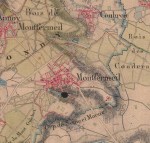
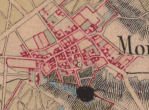
I finally found a relatively decent map of Montfermeil in more or less canon era! This is part of a military atlas (I think) that you can check out [here], and it also has other towns like Montreuil-sur-mer (look for “62170 Montreuil”). Probably very useful for fanfics too! 😀 At least if you have any need to have the characters go anywhere outside of the big cities.
I might still keep looking for even better maps but this is way more than I’ve found before 😀 You can also see the shape of the land which Hugo describes in the Brick (2.3.1: The Water Question At Montfermeil):
Montfermeil is situated between Livry and Chelles, on the southern edge of that lofty table-land which separates the Ourcq from the Marne. (…) it was a peaceful and charming place, which was not on the road to anywhere: there people lived, and cheaply, that peasant rustic life which is so bounteous and so easy; only, water was rare there, on account of the elevation of the plateau.
MORE UNDER THE CUT BECAUSE THIS TURNED OUT A BIT LONG (surprising nobody who knows me)
Okay, so sticking with the idea of “unpopular” as just “not something I see a lot of” rather than an argument
there is really nowhere NEAR enough discussion of how hilaritragic Enjolras’ entire existence is?? I don’t mean like, in terms of Suffering–none of the Amis lead the pack on that one in the Brick– but in terms of narrative structure, like
I know I said this the last time I read the book, but it gets me, every time, that Hugo takes the time to show us how scared Cosette is, how everything around her is utterly terrifying, how she fears the shadows of the wood, and she fears the hand of Madame Thénardier, and then, then –
“Il y a des instincts pour toutes les rencontres de la vie. L’enfant n’eut pas peur.”
Look. It’s so important. It’s not like Valjean isn’t scary, that huge dark man, suddenly here besides her when she was alone a moment ago. But Cosette isn’t scared of him a single moment. It takes one question of him, one hint of interest, for her to babble about her home life, eager for more sympathy.
Why is Cosette the face of the musical, rather than Jean Valjean?
Reasonable question! The musical, even more than the book, is very About Jean Valjean, his journey and his plotline. But the musical isn’t JUST about Valjean; it’s also about Fantine, about Marius, about an uprising, about the Thenardier Family, and so on.
And Cosette is the thread that ties it all together.
Without Cosette, the story (of the musical) is :
Valjean redeems himself through his behavior at M-sur-M and (possibly!) his act of sacrifice at the Champmathieu trial.
Fantine stays in Paris; Valjean never meets her.
Javert either never tells Valjean about Champmathieu (because he’s not pressing suspicions due to Fantine’s arrest), and Valjean stays as mayor, end of story, Javert either goes on with his life in the service of the now-exonerated (in his mind) Mayor Madeleine,
OR: Valjean goes to jail (and stays there, without duty to Cosette driving him to find another way) and Javert goes on his way with the satisfaction of a job rightly done. Neither of them ever has to confront the choices and character growth that come their way in the existing story.
Marius never even considers not being part of the barricade fight; and he dies with everyone else there. *Including* Eponine and Gavroche, who are there for their own reasons.
And all of these are complete stories! Every one of these characters serves as the hub of an entire plot, with other characters affected by them and their choices!
But the only reason they’re part of the SAME story is because of Cosette. Because of Cosette, Fantine goes to Valjean’s factory. Because of Cosette, Valjean finds a way to keep moving ahead after the trial, and eventually goes to Paris. Javert’s suicide, Marius’ survival at the barricade–they happen because Valjean loves Cosette enough to be there (and because Marius loved Cosette enough to consider NOT being there, and send Eponine off with a note–and in the world of the musical, this may be why Eponine’s at the barricade too, but that’s a consideration for another time.)
Valjean’s line– “It’s the story of those who always loved you”– could stand for the whole musical. I’ve seen that post saying Marius is only there because Valjean loves Cosette, but really you can track that back–VALJEAN only connects with any of these people because Fantine loved Cosette. It’s the story of people who love Cosette, and how that transforms them and the people they meet.
No, none of this is intentional on Cosette’s part, but hey, that’s part of the point of this story– no one knows what they’re doing, no one’s got a Master Plan, everyone’s just moving forward the best they know how. What brings people together, through all the confusion, across classes and war and all kinds of social prejudice, is love, and that’s what Cosette does, and what she represents.
And that’s why Cosette is the face of the musical.
WHY THE THENARDIERS THOUGH? HUGO HAS VILLAINS PLAYED FOR COMEDY. HE HAS GILLENORMAND AND HE HAS MONTPARNASSE. WHY DOES THE MUSICAL INSIST ON DOING IT TO THE THENARDIERS INSTEAD?
I KNOW, the Thenardiers are just so awful and they never STOP being awful, they’re NEVER “Loveable Rogues”, even in the play Mme T’s first appearance is in seriously THREATENING TO BEAT A CHILD?!? Anyone who thinks that’s Wacky Fun kind of worries me.
I think maybe it’s because they’re THERE from an early point? But like there’s no comedy relief in the first bit of Les Mis, there just really isn’t The hijinks are with THE GUYS WHO ALL DIE There are REASONS for that but (while I totally get that the play is what it is now and directors just have to work with that) I think, like, if they HAD to have some wackiness in the first chunk Fauchelevent would have made a lot more sense?? He’s kind of an antagonist at first, even!
i can think of no other reason than “this musical is too damn somber we need comic relief.” you see, the musical could have introduced the thenardiers with a dark and dreary song, but at that point in the musical, the audience would have seen 1) a convict wrongly punished, 2) a woman hitting rock bottom and dying, 3) said convict having to run for his life again. they need a rest. hence, master of the house. true, i never really got to enjoy MoTH because of the undertones, but melody-wise, it’s a savior.
as for fauchelevent, that would entail using an actor for one short scene and having him join the ensemble afterward. it’s a waste of an actor, and is probably the reason gillenormand was scrapped from the original french concept. the thenardiers play largely in the story and can’t be scrapped like fauchelevent and gillenormand (and even montparnasse), so since they have to be there in the first place, might as well use them for comedy.
note though, i don’t endorse them as comic relief either, but i can only explain how it probably went on in the creative process for the adaptation.
Yeah, my husband and I argue about this all the time. “How can you make the Thenardiers funny!” I say. “They’re horrible people!” “You need some levity or the musical will be too overwhelming and no one will watch it!” he says. “The Thenardiers make more sense than anyone else!” “You don’t need levity in a musical!” I say. “Look at Sweeney Todd!” “Sweeney Todd is funny ALL THE TIME,” he says. “There’s a funny song about cannibalism, FFS! That is a horrible example!” Etc.
I haaaaaaaaate what they did with the Thenardiers because it lessens their menace, especially their abuse, and because it means that most of the social commentary Hugo was using the Thenardiers to make has been lost (there is a little bit of it in Dog Eat Dog, but oh so little). That carries over into Eponine, as well — I think it would have been easier to get her actual story across, rather than shunting her into the ‘unrequited love’ role, if her family had been portrayed as something other than comic relief. Eponine is supposed to be a lecture on agency and poverty, but it’s hard to communicate that if you aren’t explicit about what her family life was like, and associated with that, what her future would have been.
But the worst thing is, while I’m right, my husband is as well. The musical does need some levity, and it needs levity, as Hana points out, exactly when the Thenardiers show up, timing-wise. I bitch about how the musical compresses things and glosses over things and cuts things and then dwells on the wrong things ALL THE TIME because that means so much of the story and its attendant messages are lost, but honestly, as a musical, it’s actually paced really well. (It wouldn’t be such a success if it wasn’t.) The Thenardiers might be misused, but the musical wouldn’t work nearly as well if they weren’t.
Beggars at the Feast should still be excised from all existence, though.
You know, I actually don’t mind comic Thénardiers… when they’re funny in the same way Sweeney Todd is funny. When they are so awful the awfulness comes right out the other end into helpless laughter, and it makes you feel almost guilty for laughing so fucking hard, then comic Thénardiers is a thing that works. Thénardier has a slightly easier job in this department than Mme T–before the whole accursed jolly-hockey-sticks panto-slapstick trend got started, I saw a number of excellent Thénardiers, but the only Mme T’s I saw who managed to wring that kind of involuntary horrified laughter out of the audience were Jennifer Butt and Jenny Galloway, both of whom are pretty much the best of the best.
Okay so I wanted to meta about Le Cabuc/Claquesous so here it is.
As I was reading through the Le Cabuc section the other day I was wondering about the characterization of Le Cabuc vs the characterization of Claquesous that we get. Claquesous is mysterious, he’s stony, he’s silent. He’s a ventriloquist who changes his every aspect in order to remain anonymous. He takes orders from no one, not even Thenardier, really. He comes out only at night and is described as “coming out of a hole”. No one knows his real name, no one knows his real voice, no one knows his real anything. Even Javert mentions that no one ever sees him. He is smoke and mirrors, he is darkness, he’s a ghost. He’s barely even real. He could almost be a sort of mythical criminal made up by the crime ring of Paris, a thing to become or look up to or be warned of. Basically, he is the cold, invisible, intangible person, practically just an idea, but he is well known and everyone has heard of him.
And then we have Le Cabuc. Le Cabuc is “entirely unknown,” he “articulated and vociferated”, which is the exact opposite of the near-silent Claquesous. He is friendly(ish) and heavily drunk and drinks with others and pulls a table out of the bistro to drink with others. And then, when he wants to get in the house, he doesn’t revert to the means he might have as Claquesous, sneaky things or trickery or something like that. He goes directly to yelling, to firing his gun, to bringing attention to himself. He is angry, volatile, making a scene. And then, when he kills the civilian in the window, Enjolras is there. Enjolras pushes Le Cabuc to his knees despite the man being larger and broader and probably physically stronger than he. And even when Enjolras pushes him down, he still struggles. It’s when the revolutionaries make a wide ring around the both of them that he stops, that he “trembles in every limb”, that he asks pardon of Enjolras. When Enjolras kills him, he is writhing against Enjolras’ knees and howling (which I assume means he’s begging for his life), the complete opposite of anything we might have seen in Claquesous.
So the question is, is this really Claquesous? Is this the “real” Claquesous? Is Le Cabuc the Claquesous with the mask pulled away, Claquesous without his ventriloquism and without the cover of darkness? It’s mentioned more than once that Claquesous only ever emerges under the cover of darkness, and no one knows what he looks like. Is he a criminal by night and a “regular” citizen by day? Or is Le Cabuc just another one of Claquesous’ masks, a new ventriloquism, a great act, and one he dies playing?
*holds this meta close and cries*
LEX, I LOVE YOU
My personal belief is that the real Claquesous, the one without his “mask”, is Le Cabuc – when he reveals himself as human, he makes himself vulnerable, and so he can be killed. I see “Claquesous” as being the persona, and when he lets that slip, his whole safety-net collapses too
Oh, and these are some rambly notes I made after you first said you were going to write this (sorry that they’re a bit incoherent):
Claqusous is introduced as being really, really mysterious – in my (shitty Denny) edition, the very first thing Hugo says about him is that he is “darkness incarnate”. Things I associate with darkness: uncertainty, fear, the supernatural – he is all these things. I kinda think that Claquesous, at least at first, can indeed be seen as the physical embodiment of darkness and the night:
Uncertainty: he’s faceless, has no concrete identity. He’s said to employ a series of masks rather than a face, and nobody knows his real name. No-one knows where he lives, and it’s doubtful that he has a permenant location anyway, as he seems to be rootless – as he’s described as “roving”, you can’t pin him down. Babet calls him “’the night-bird with two voices’“ – Les Miserables is very much concerned with the idea of giving a voice to the voiceless, and Claquesous defies that. He doesn’t want to use his real voice, as his strength lies in being enigmantic
Fear: Hugo describes him as “frightening”, and you can totally see why
The Supernatural: He only seems to exist at night, more of a phantom than a human being – indeed, Hugo says he “vanished like a ghost” whenever he had need to. He’s almost vampiric, said to “creep[] out of his hole at dusk” and then return “at daybreak”
Basically, the guy lives in mystery and darkness – he’s said to even evade the questions of his fellow criminals, so keen is he to maintain his air of elusiveness. It seems like his mysteriousness isn’t just his defining characteristic (if he can even be said to have one), but also his strength
Hence, as Le Cabuc, he is able to be killed as he’s lost his armour of shadows – he shows himself as a mortal man, not an intangible ghost, and so is at last made vulnerable
He “tremble[s]”, “gasp[s]”, swears and “scream[s]” before his finally laid face-down on the cobbles – he dies not just human, but human at its most base, basic level, acting solely on fear, with no regard to dignity
And another thing I find really fascinating is that when when Enjolras has shot him, he’s not even a man anymore, but a thing. Enjolras tells the other men to “Get rid of that”, referring to Claquesous’ body, and from then on he is referred to as “it”, not “he” – “three men picked it up, still twitching in its last death-throes, and flung it over the smaller barricade into the Rue Mondetour”. He’s inhuman again, but not in the same way that he was first presented
And then the last we hear of him, when Hugo confirms that Le Cabuc and Claquesous are the same person, is “his life had been lived in shadow, his end was in total darkness”. It’s as though the darkness he’s always cloaked himself in and used as his safety has at last consumed him, once again rendering him incorporeal
Oooh yes.
Claquesous embodies the confident expression and use of uncertainty and fear to subdue and manipulate others, while Le Cabuc is consumed by his fear and made base by it. He wraps himself in a character and a mask when he is with Patron Minette, but as Le Cabuc he is a man, not an idea. He is physically vulnerable, but he is also emotionally vulnerable. He isn’t cold and distant like Claquesous. He’s drunk and brash and friendly, and angry and volatile. Claquesous would never have impulsively shot the man in the window. He would not have reacted so vehemently or yelled so repeatedly at the man. He resorts to yelling, to beating the door, to open violence, whereas Claquesous would have been more subtle. And he wouldn’t have howled and struggled and screamed and begged Enjolras, either. But this is not Claquesous, not anymore. This is Le Cabuc the human, letting out all the things that Claquesous hides.
I also find it really interesting that Hugo switches over to present tense when he speaks about Le Cabuc hitting the door. I don’t know whether that’s a typo in my translation, a mistake on his part, or purposeful symbolism, though I don’t know exactly what it would mean.
Personally I like my (FMA) translation: “His life had been darkness, his end was night.” Claquesous life had been darkness. He surrounded himself with it, he made use of it, he embraced it and became it. To him, darkness was a good thing. But his death, his end? It was night. He was smothered by it, he was taken by it. It came swiftly and covered him entirely. His death was not an enveloping fog he could hide himself in, the mists of his masks and changing identity. It was above him in the form of Enjolras as an elevated figure. He is the night, the base, the violence they are fighting against, and Enjolras is the light, the sun, the thing that destroys the night, that brings end to the night. It doesn’t bring an end to the darkness: there are always going to be shadows, especially when there is sun, but it ends night.
Ah, it’s That Chapter in Brickclub! I always find this post to be enormously helpful in understanding thecultural context for Mme. T’s novels here. I actually wish it wasn’t all behind a cut, it’s just so much useful context!–Especially the bit about how a lot of the novels Hugo’s citing were by men “legitimizing” fictional forms women created by …writing the same thing but being men, and by how the specific narrative through-line of them ties in with Mme T’s expectations for herself and her girls.



 ¯_( ಠ_ಠ)_/¯